
PeptidePick preferred picks
Use the highest-value vendor routes first.
Pinnacle is first for the 15% discount code. Ascension is the broad-catalog default when you want the cleaner research-only route.
Research-only affiliate links. Verify COAs, labels, and shipping terms before checkout.
AOD-9604 peptide: fat loss research, dosage, and sourcing guide
TL;DR
- AOD-9604 is a modified fragment of human growth hormone built around the 176-191 region, but it is not the same thing as full HGH.
- Early animal work reported reduced fat accumulation and increased lipolysis, yet the human data is much thinner than many sales pages suggest.
- A 24-week randomized trial in obese adults did not turn AOD-9604 into a mainstream approved obesity drug, which matters when you compare it with modern GLP-1 research compounds.
- The peptide is banned in sport under WADA peptide hormone rules, and it is sold almost entirely for research use rather than regulated clinical use.
- For buyers comparing vendors, the biggest quality filter is third-party testing, transparent lot data, and realistic claims instead of miracle-fat-loss copy.
The search interest around AOD-9604 peptide usually comes from one question: does this old growth-hormone fragment still deserve attention now that semaglutide, tirzepatide, and retatrutide dominate the weight-loss conversation? The short answer is maybe, but only if you keep the evidence in proportion. AOD-9604 has interesting preclinical data and a long trail of internet hype. It does not have the same level of human proof as the newer GLP-1 class.
That gap matters. If you are comparing research compounds, you need to separate mechanistic promise from clinical reality. This guide does that, then points you to tools like our free peptide reconstitution calculator, our step-by-step guide on how to reconstitute peptides, and our full roundup of the best peptide companies.
What is AOD-9604 peptide?
AOD-9604 is a synthetic peptide derived from the C-terminal region of human growth hormone, commonly described as the 176-191 fragment with a small modification to improve stability. Researchers originally became interested in this segment because earlier lab work suggested the fat-metabolism activity of growth hormone might be separated from its growth-promoting effects.
That is the main pitch. In theory, a fragment like AOD-9604 could influence fat metabolism without producing the broader endocrine effects seen with full HGH. But theory is not proof, and that distinction gets lost fast in affiliate-heavy content.
Older obesity research gave the peptide some momentum. Animal studies published in the early 2000s reported reduced body-weight gain and lower fat mass in rodents receiving the fragment. Those findings are why AOD-9604 still shows up in weight-loss forums, peptide vendor catalogs, and comparison posts alongside semaglutide, tirzepatide, and retatrutide.
Looking at weight-loss research peptides first?
Apollo focuses heavily on GLP-1 research compounds and growth-factor adjacent products, so it is a strong first stop if you want to compare AOD-9604 with better-studied weight-loss categories.
Shop Apollo GLP-1 Research Catalog →
Specializing in GLP-1 research peptides and growth factors
How AOD-9604 peptide is supposed to work
The original pitch is straightforward. AOD-9604 is studied for its potential effects on fat breakdown and fat formation, without acting like full human growth hormone on growth, blood glucose, or insulin-like growth factor pathways. Some preclinical papers reported increased lipolysis and reduced lipogenesis in adipose tissue models.
One often-cited line of research found that HGH fragment 176-191 reduced weight gain in obese mice and rats while leaving food intake mostly unchanged. Another paper suggested the fragment stimulated fat breakdown in isolated adipose tissue at levels that did not mirror the full systemic effects of HGH. That sounds promising. But many articles stop right there.
The harder question is what happened when researchers tried to turn that mechanism into a useful obesity treatment. That is where the evidence gets mixed. You can say the peptide has a biologically plausible rationale. You cannot honestly say the clinical case is already settled.
| Topic | What research suggests | What it does not prove |
|---|---|---|
| Lipolysis | Animal and lab data suggest increased fat breakdown activity | Reliable long-term fat loss in broad human populations |
| Growth hormone separation | Fragment may avoid some anabolic or diabetogenic effects associated with full HGH | Zero endocrine risk in every real-world context |
| Weight management use | Interest in obesity research led to human trials | FDA approval or guideline-level support for treatment |
What the human research actually says
This is the part most readers actually need. The human data on AOD-9604 is limited, dated, and nowhere near as strong as the marketing around it. A randomized placebo-controlled trial published in 2007 evaluated obese adults over 24 weeks and did not launch AOD-9604 into clinical obesity care. If the effect had been dramatic, you would probably know its brand name already.
That does not mean the compound is worthless as a research topic. It means the burden of proof is still high. Obesity drug history is full of molecules that looked good in theory, showed some activity early, then failed to become meaningful therapies because the real-world effect size, durability, tolerability, or commercial logic fell short.
Several points are worth anchoring here:
- The major human trial ran for 24 weeks, which is long enough to expose whether a peptide has serious traction as an obesity intervention.
- AOD-9604 did not become an FDA-approved obesity drug, while GLP-1 class agents later did.
- Preclinical studies from the Monash group and related teams helped create the mechanistic story, but that is not the same as a modern regulatory evidence package.
- Current search demand still exists. The keyword volume for this topic sits around 9,900 searches per month in the pipeline feeding this article, so the curiosity is very real.
- WADA continues to list peptide hormones, growth factors, related substances, and mimetics in its prohibited framework, which matters for tested athletes even if a compound is sold as research use only.
Competitor content usually falls into one of three buckets: thin vendor pages, generic peptide explainers, and aggressive fat-loss promises copied from older forum lore. The better opportunity is a cleaner guide that admits uncertainty, contrasts the evidence with GLP-1 compounds, and explains why sourcing quality is not the same thing as proof of effectiveness.
Want the broadest delivery-form selection?
Limitless is useful when researchers want to compare injectable peptides with spray or capsule-adjacent catalog options. Start with the VIP account link first, then apply the PeptidePick code at checkout.
Unlock Limitless VIP Catalog →
118+ research peptides in injectable, spray, and capsule forms - create a free account to access the full catalog
Create your free Limitless account first. Then use code PeptidePick for a discount at checkout
AOD-9604 peptide vs other fat loss peptides
AOD-9604 sits in a strange lane now. It is older than the current GLP-1 craze, more niche than semaglutide, and less talked about than retatrutide. Its main appeal is that it was designed around a fat-metabolism hypothesis rather than appetite suppression through incretin signaling.
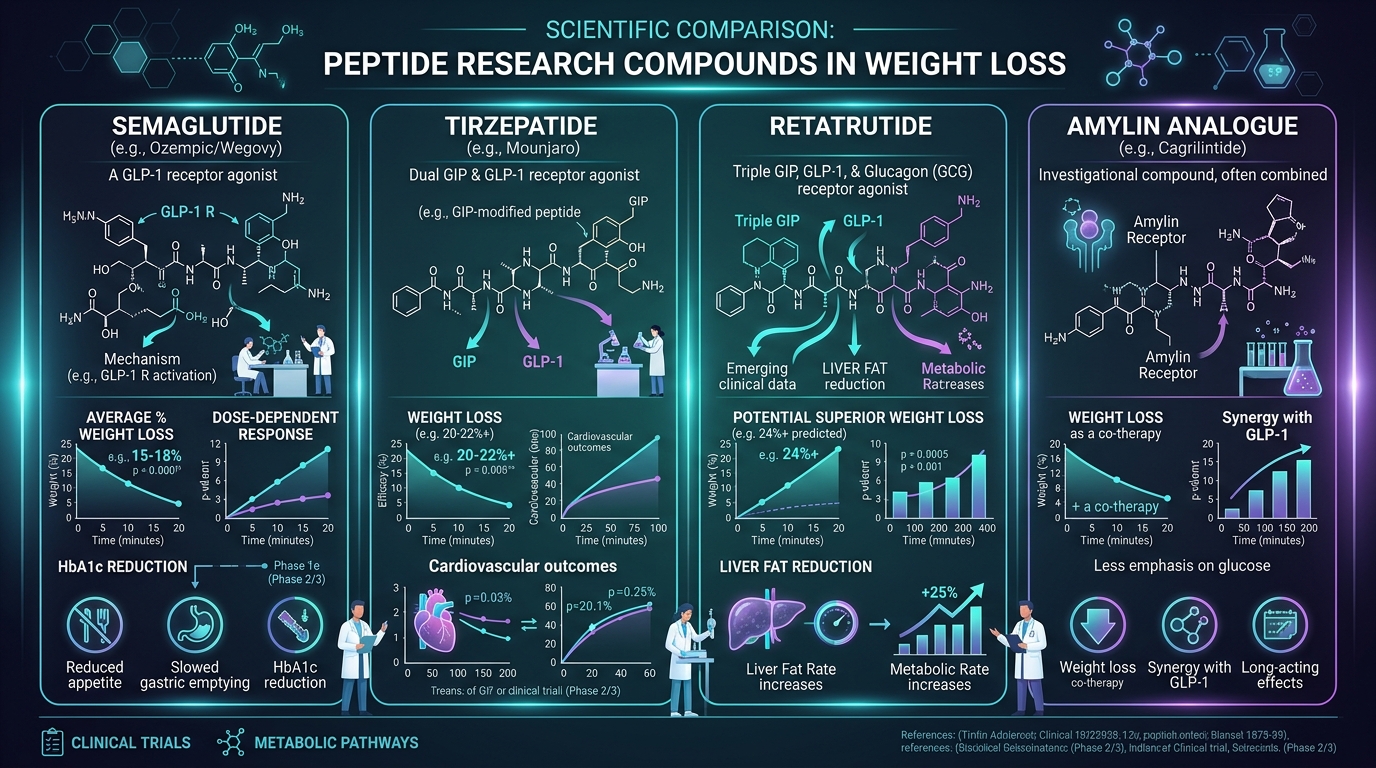
That difference has practical consequences. If someone is researching compounds for body-composition outcomes, peptides for weight loss now means comparing very different mechanisms. Semaglutide and tirzepatide have extensive modern human data. AOD-9604 does not.
So the question is less "is AOD-9604 interesting?" and more "does it still deserve priority in a 2026 research shortlist?"
For many readers, the answer is probably no unless they specifically want to study older fat-metabolism peptide hypotheses. Still, there is a case for covering it because AOD-9604 represents a different generation of obesity research. Looking backward helps explain why newer agents overtook the category.
- AOD-9604: old-growth-hormone-fragment concept, narrow human evidence base, not FDA approved.
- Semaglutide: extensive obesity data, regulatory approvals in other branded contexts, strong appetite and weight outcomes.
- Tirzepatide: dual incretin action and stronger average weight-loss outcomes than earlier single-pathway agents in many datasets.
- Retatrutide: still investigational, but far more current in obesity research discussions than AOD-9604.
If your goal is simply comparing sourcing, our guides on recovery peptides and anti-aging peptides can help frame how vendor quality standards carry across categories.
Dosage and sourcing questions researchers ask
The phrase "AOD-9604 dosage" gets searched constantly, but this is where caution matters. There is no FDA-approved dosing framework for AOD-9604 in a legitimate therapeutic context. What you mostly see online are vendor suggestions, forum anecdotes, and recycled protocol charts. Those are not the same as validated medical dosing guidance.
A better sourcing checklist looks like this:
- Is the vendor publishing current third-party purity or identity testing?
- Can you verify the lot number or certificate and confirm it is not a fake PDF?
- Does the listing clearly say research use only rather than pretending it is a prescription medicine?
- Does the vendor avoid impossible claims like targeted belly-fat melting in days?
- Do they also stock adjacent compounds so you can compare categories without getting pushed into one hype cycle?
That last point matters more than people think. A decent research supplier should help you compare options, not trap you inside a sales narrative. If you are still evaluating where to buy, our main vendor roundup at best peptide companies is the baseline page to bookmark.
For practical prep questions, use the reconstitution resources already mentioned before you trust any random chart. And if you are comparing AOD-9604 with compounds that get more attention in recovery or tissue repair circles, pages like BPC-157 guide and TB-500 guide show how wildly different the evidence bases and claims can be across peptides. BPC-157, in particular, needs the usual caveat that much of the early work traces back to the Zagreb research line and the FDA has warned about significant safety risks.
Need a vendor with broad catalog depth and a standing discount?
Pinnacle is useful for comparing weight-loss, recovery, and longevity compounds in one place, especially if you want 99% purity claims plus a sitewide discount code.
99% pure research peptides - use code Peptidepick15 for 15% off
Use code Peptidepick15 for 15% off your order
Some readers also want a non-injectable route. If the real goal is body-composition support without entering injectable peptide territory, Nootropics Depot is the better framing. It is an oral supplement company, not an injectable peptide vendor, so it works as an alternative or complement rather than a substitute for AOD-9604 research stock.
Legal status, safety, and testing risk
AOD-9604 is not FDA approved. That should be stated plainly. It also appears in anti-doping conversations because WADA prohibits peptide hormones, growth factors, related substances, and mimetics. If an athlete is drug tested, the "research use only" label does not make that risk disappear.
Safety is another place where online content often gets sloppy. Older sources sometimes describe AOD-9604 as free of the glucose issues associated with full growth hormone exposure. Even if that was part of the developmental logic, it does not justify calling the peptide broadly safe. Lack of approval, limited human evidence, uncertain product quality, and the way grey-market peptides are stored and reconstituted all add risk.
So where does that leave AOD-9604 in 2026? In my view, it is best understood as a legacy fat-loss research peptide with an interesting backstory and modest practical priority. It still earns a spot in comparative content because people search for it. But if you asked which compounds have the strongest current evidence for obesity outcomes, AOD-9604 would not be near the front of the line.

Study references and evidence worth checking
If you want to verify the core claims in this guide, start with the research trail that created the peptide's reputation:
- Ng FM and colleagues on the lipolytic region of growth hormone and the fragment research that fed AOD development.
- Heffernan MA et al. on anti-obesity effects of the human growth hormone fragment in rodent models.
- Randomized placebo-controlled obesity trial data published in 2007 evaluating AOD-9604 over 24 weeks.
- WADA prohibited list and technical documents covering peptide hormones, growth factors, and related substances.
- Reference explainers from Drugs.com and similar medical databases that note the lack of FDA approval and investigational status.
That mix is enough to keep the article grounded. It also shows why certainty is the wrong tone here. There is a story, there is some data, and there is clear market demand. But there is also a reason AOD-9604 stayed on the fringe while other obesity compounds moved into mainstream clinical discussion.
Related articles
FAQ about AOD-9604 peptide
Is AOD-9604 the same as HGH fragment 176-191?
It is closely related, but AOD-9604 is typically described as a modified version of the HGH 176-191 region rather than a simple unmodified fragment. That distinction matters when you read vendor listings and old study summaries.
Is AOD-9604 FDA approved?
No. AOD-9604 is not approved by the FDA for obesity treatment or any other medical use.
Does AOD-9604 peptide work for fat loss?
Preclinical data suggested possible fat-metabolism effects, but the human evidence is limited and not strong enough to place AOD-9604 in the same category as current GLP-1 weight-loss research compounds.
Why do people still search for AOD-9604?
Because it has an older reputation as a "fat-loss peptide" that might avoid some full-growth-hormone effects. Search interest stays high even when the clinical evidence is not especially modern.
Is AOD-9604 banned in tested sports?
Peptide hormones, growth factors, related substances, and mimetics fall under WADA prohibition rules, so tested athletes should treat AOD-9604 as a serious anti-doping risk.
Where should researchers start before buying AOD-9604?
Start with vendor verification, lot-specific testing, and preparation basics. Our best peptide companies guide, reconstitution guide, and mixing calculator are the best first stops.
For vial math and protocol examples, see the AOD-9604 dosage guide.