
Best GLP-1 Peptide for Minimal Side Effects: Comparing Semaglutide, Tirzepatide, and Retatrutide
The best GLP-1 peptide for minimal side effects depends less on hype and more on which adverse events show up most often in trials, how fast the dose rises, and how much GI discomfort a person can realistically tolerate. Across the strongest obesity data available, tirzepatide usually shows lower nausea and vomiting rates than semaglutide, while retatrutide looks more aggressive on both weight loss and side-effect burden at higher doses.
Vendor shortcuts
Compare the right source before you keep reading
Pick the lane that matches your research goal, then verify current COAs, label language, and shipping policy on the vendor page.
Research-only affiliate links. PeptidePick may earn a commission at no extra cost to you.
TL;DR
- Tirzepatide has the cleanest overall GI profile of the three based on headline obesity trial rates.
- Semaglutide is backed by large real-world familiarity, but nausea and vomiting rates were higher in STEP 1 than tirzepatide in SURMOUNT-1.
- Retatrutide may produce the largest weight-loss effect, but current phase 2 data show the widest dose-related side-effect range and it is still investigational.
- Slow titration, smaller meals, hydration, and early dose holds matter almost as much as compound selection.
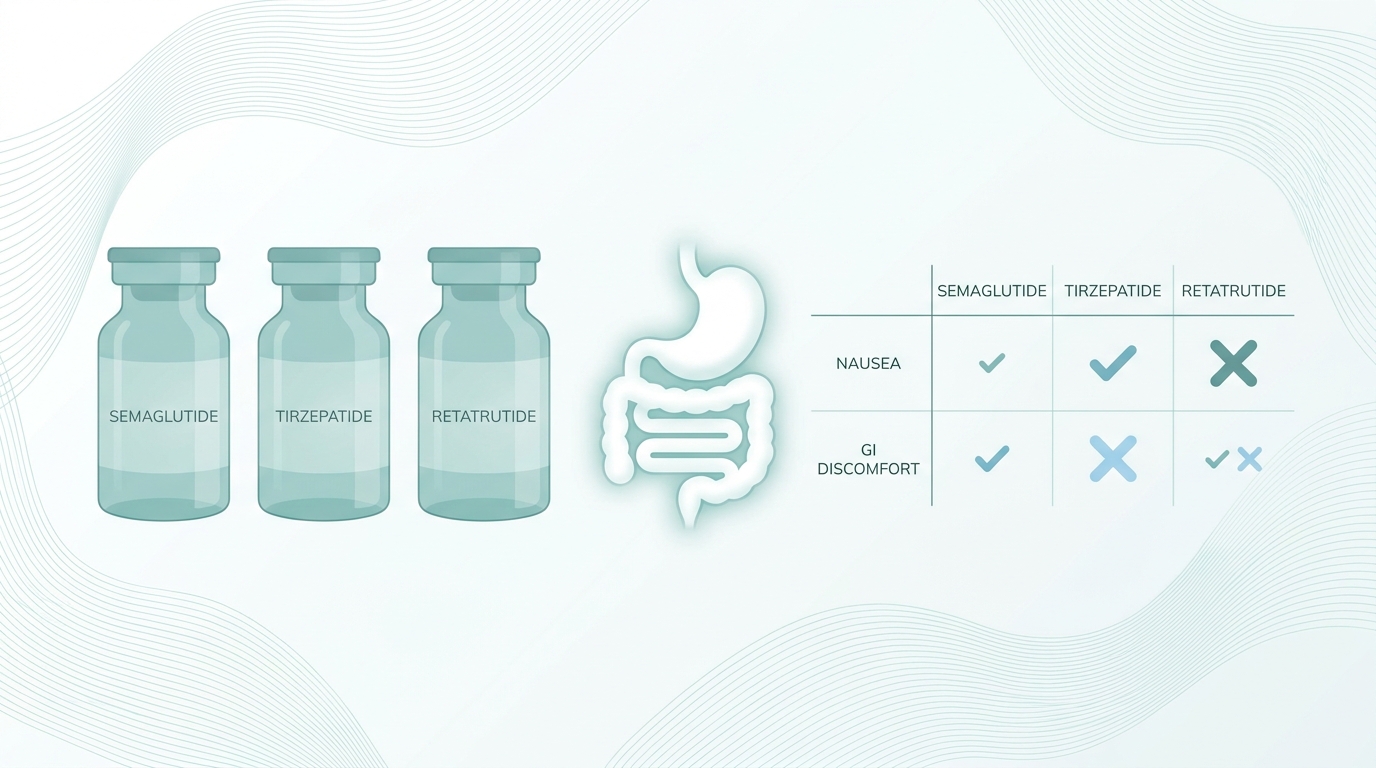
Which GLP-1 looks easiest to tolerate?
If the goal is the lowest average GI burden among semaglutide, tirzepatide, and retatrutide, tirzepatide currently has the strongest case. In SURMOUNT-1, nausea was reported in roughly 24 to 33 percent of participants depending on dose, vomiting in 8 to 12 percent, diarrhea in 18 to 23 percent, and constipation in 11 to 17 percent.
Semaglutide in STEP 1 came in higher on several of those same measures: nausea 44 percent, diarrhea 31.5 percent, vomiting 24.8 percent, and constipation 23.4 percent. That does not automatically make tirzepatide better for every person, but it does give it the best average tolerability signal in a head-to-head style reading of the trial data.
Retatrutide is more complicated. Early results are impressive for weight loss, yet phase 2 obesity data showed nausea rates from 28 to 58 percent and vomiting from 6 to 35 percent depending on the arm, which is hard to ignore if side effects are the main decision point.
Looking for GLP-1-focused research inventory?
Apollo Peptide Sciences is the cleanest first stop for readers comparing semaglutide, tirzepatide, and retatrutide research options.
Shop Apollo Peptide Sciences →
Specializing in GLP-1 research peptides and growth factors
Side-effect rates in the trials
The simplest way to compare side effects is to line up the obesity trial data and look for repeat patterns. Cross-trial comparisons are never perfect because the populations, titration schedules, and endpoints differ. Even so, the broad signal is useful.
| Compound | Key trial | Nausea | Vomiting | Other common GI effects | Regulatory status |
|---|---|---|---|---|---|
| Semaglutide | STEP 1, NEJM 2021 | 44% | 24.8% | Diarrhea 31.5%, constipation 23.4% | FDA-approved in branded products for diabetes and obesity depending on formulation |
| Tirzepatide | SURMOUNT-1, NEJM 2022 | 24-33% | 8-12% | Diarrhea 18-23%, constipation 11-17% | FDA-approved in branded products for diabetes and obesity depending on formulation |
| Retatrutide | Phase 2 obesity trial, 2023 | 28-58% | 6-35% | Diarrhea 16-27%, constipation 17-26% | Investigational, not FDA-approved |
Semaglutide also had a higher GI-related discontinuation signal in STEP 1, with 4.5 percent stopping for GI events versus 0.8 percent on placebo. Tirzepatide discontinuation due to adverse events ranged from 4.3 to 7.1 percent across dose groups in SURMOUNT-1 versus 2.6 percent on placebo, so the picture is not one-dimensional.
That is the nuance many ranking articles miss. One drug can post lower nausea on average yet still have enough dose-related drop-off to matter if someone pushes escalation too fast.
What the data suggest
- Tirzepatide looks most favorable if nausea minimization is the main metric.
- Semaglutide has more mature usage history and still may be easier to manage for some people because clinicians know its titration playbook well.
- Retatrutide looks least attractive for side-effect-sensitive readers right now because higher-dose arms had wider GI event ranges.
People searching this topic are usually asking one of four things: which option causes the least nausea, whether tirzepatide is gentler than semaglutide, whether retatrutide is worth waiting for, and how to make GLP-1 side effects more manageable. That matches what is already ranking, but most competitor pages blur prescription products and research peptides too aggressively.
That distinction matters. Semaglutide and tirzepatide may appear in research supplier catalogs, but those products are not the same thing as branded prescription medications with regulated manufacturing, labeling, and dispensing controls.
For a wider sourcing framework, readers can compare vendors in this best peptide companies guide before looking at any specific GLP-1 listing.
Why dose escalation changes everything
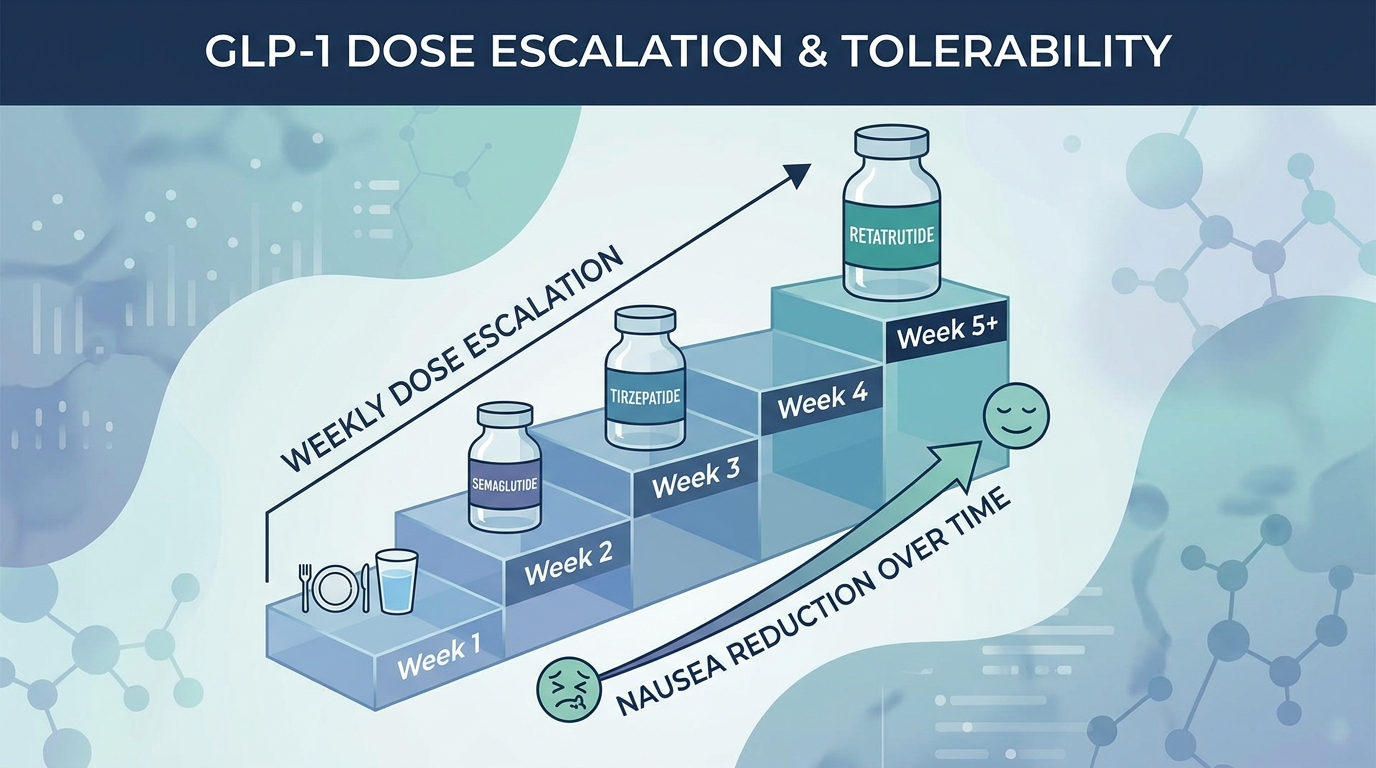
Side effects are not just compound-specific. They are often titration-specific. Most GLP-1 GI complaints spike during escalation, especially after dose jumps that outpace appetite adaptation and delayed gastric emptying.
That helps explain why retatrutide can look rougher in some arms. Higher doses tend to produce stronger efficacy signals, but they also push nausea, vomiting, and early dropout risk higher.
Tirzepatide benefits from a step-up approach that, at least in published obesity data, appears to keep GI issues more contained than many people expect. Semaglutide can also be manageable, but the trial percentages suggest that slow escalation is not optional if minimal side effects are the goal.
Practical dose-escalation lessons from the research
- Early low doses are usually about tolerability, not maximum effect.
- Large meals and high-fat meals tend to worsen nausea during escalation.
- Short pauses or delayed step-ups are common ways clinicians reduce dropout risk.
- Persistent vomiting, dehydration, severe abdominal pain, or inability to keep fluids down warrant medical review.
Want broader delivery-form options for GLP-1 research?
Limitless Biotech stands out for catalog depth and multiple formats. Start with the VIP link first, then use the discount code at checkout.
Create your free Limitless Biotech account →
118+ research peptides in injectable, spray, and capsule forms - create a free account to view the full catalog
After signup, use code PeptidePick for a discount at checkout.
Who may prefer each option
Tirzepatide makes the most sense for readers who want the best current balance of strong weight-loss data and a comparatively lighter GI profile. The existing obesity trial record gives it the cleanest headline tolerability case among the three.
Semaglutide still belongs in the conversation because it has broader name recognition, a long clinical runway, and predictable counseling points. Some people tolerate it better than expected despite the higher average nausea rate in STEP 1.
Retatrutide is the wait-and-watch option. It may become a major future contender, but right now the combination of investigational status and more volatile GI figures makes it hard to call the best GLP-1 peptide for minimal side effects.
Individual variation remains a real wildcard. A lower average nausea rate does not guarantee better tolerability for every person, and two people on the same compound can have very different first-month experiences.

How to reduce GLP-1 side effects
The best side-effect strategy is usually boring. But it works.
- Eat smaller meals during escalation instead of trying to push through normal portion sizes.
- Keep fat intake moderate when nausea is active, since richer meals often hit harder.
- Hydrate aggressively if appetite drops and vomiting or diarrhea appears.
- Slow the titration or hold the dose if symptoms rise sharply after an increase.
- Watch for red flags such as persistent vomiting, severe abdominal pain, faintness, or dehydration.
Readers who are still learning injection math should use this free peptide reconstitution calculator and review how to reconstitute peptides before handling any research vial. For broader weight-loss context, see peptides for weight loss, this semaglutide guide, tirzepatide vs semaglutide, and retatrutide vs semaglutide.
How to read these side-effect numbers without fooling yourself
Trial percentages are useful, but they need context. A study can show lower nausea overall while still hiding a rough first few weeks for people who are sensitive to delayed gastric emptying or who move up doses too quickly.
It also matters whether a trial reports any event, treatment-related events, or discontinuations. A person may have two mild nausea episodes and still finish the study, while another participant may stop early after a smaller number of symptoms because the disruption is worse for daily life.
That is why discontinuation data are worth watching beside the headline nausea rate. Semaglutide had higher GI-event discontinuation than placebo in STEP 1, and tirzepatide still showed dose-related adverse-event drop-off in SURMOUNT-1 even though its average GI rates looked better than semaglutide.
Retatrutide adds another layer because the weight-loss upside is large enough that some readers may accept more side effects. But if the brief is minimal side effects, not maximum weight loss, the current evidence still pushes it behind tirzepatide.
What many ranking pages get wrong
A lot of pages ranking for this topic flatten everything into a simple winner. That reads well, but it skips the messy part: side effects rise and fall with dose, meal size, prior tolerance, and how aggressively someone chases appetite suppression.
Another common mistake is treating prescription products and research compounds as if they are the same channel. They are not. The clinical data in this article come from named obesity trials using regulated development pathways, while vendor listings discussed here are framed strictly as research-supplier options.
The better question is not just, "Which GLP-1 is strongest?" It is, "Which one gives the best chance of staying on protocol without the GI burden becoming the whole story?" On that question, tirzepatide keeps landing in the most favorable spot.
Research sourcing and vendor notes
For a GLP-1 article like this, Apollo Peptide Sciences is the logical first CTA because its catalog lines up well with semaglutide, tirzepatide, and retatrutide research demand. Limitless Biotech follows because it offers the broadest delivery-form variety and a VIP signup flow that matters for affiliate tracking. Pinnacle Peptide Labs fits well as the value CTA because its GLP-1 lineup is solid and the discount code is straightforward.
That said, none of these suppliers should be treated as interchangeable with prescription manufacturers. Research compounds sit in a different category, and legal status, quality controls, and intended use framing matter. Readers should also review are peptides legal before ordering anything tied to an active drug class.
Need a lower-friction discount CTA for GLP-1 research shopping?
Pinnacle Peptide Labs is a strong backup pick if you want broad peptide coverage and a clear savings hook.
99% pure research peptides - use code Peptidepick15 for 15% off
Use code Peptidepick15 for 15% off your order
Final verdict
If the question is strictly which option has the best current chance of minimal side effects, tirzepatide is the strongest answer. It does not win because it is side-effect free. It wins because its obesity trial rates for nausea and vomiting were generally lower than semaglutide, while retatrutide still looks too side-effect-heavy and too early-stage to recommend on tolerability grounds.
Semaglutide remains a very close second because it is established, effective, and familiar. But based on the best published numbers, it is harder to label as the gentlest option.
Retatrutide deserves attention, yet the current data make it more of a future watchlist compound than the best GLP-1 peptide for minimal side effects today.
Frequently Asked Questions
1. Which GLP-1 has the lowest nausea rate?
Among semaglutide, tirzepatide, and retatrutide, tirzepatide posted the lowest nausea range in the major obesity data most readers care about. Trial design differences still matter, so it is not a perfect apples-to-apples answer.
2. Is tirzepatide easier to tolerate than semaglutide?
Based on SURMOUNT-1 versus STEP 1, tirzepatide looks easier to tolerate on average for nausea and vomiting. Real tolerability still depends on titration speed, meal size, and individual response.
3. Does retatrutide have more side effects?
Current phase 2 data suggest retatrutide can have a heavier GI burden at higher doses. It also remains investigational, so there is less real-world experience behind it.
4. What helps reduce GLP-1 nausea?
Smaller meals, slower dose escalation, avoiding heavy high-fat meals, and staying hydrated are the most consistent practical steps. Persistent vomiting or dehydration signs need medical attention.
5. Are research peptide versions the same as prescription brands?
No. Research peptide vendors are not the same as regulated prescription manufacturers, and their products should not be framed as equivalent to branded FDA-approved drugs.
6. Is retatrutide FDA-approved?
No. Retatrutide is investigational and has not received FDA approval.