
FDA disclaimer: This article is for educational research purposes only. Research peptides discussed on PeptidePick are not intended to diagnose, treat, cure, or prevent any disease. Injection technique, sterile handling, and dosing decisions belong with a licensed medical professional.
Best Gauge Needle for Peptide Injections: Size, Length, and Safety Guide
The best gauge needle for peptide injections is usually a short insulin syringe in the 29G to 31G range for subcutaneous research handling. Most peptide users are trying to solve the same practical problem: thin enough for comfort, but not so thin that drawing liquid from a vial becomes annoying or inconsistent.
For most subcutaneous setups, a 30G or 31G needle with a 5/16 inch or 1/2 inch length is the common starting point. A 29G needle can make thicker or colder solutions easier to draw. The right answer depends on injection route, body composition, vial stopper resistance, and whether the syringe has a fixed needle.
TLDR: For subcutaneous peptide injections, 30G x 5/16 inch is the best all-around needle size for many research setups. Choose 31G if comfort matters most and the solution draws easily. Choose 29G if draw speed matters more. Do not reuse needles, do not share supplies, and place used sharps directly into an FDA-cleared sharps container.
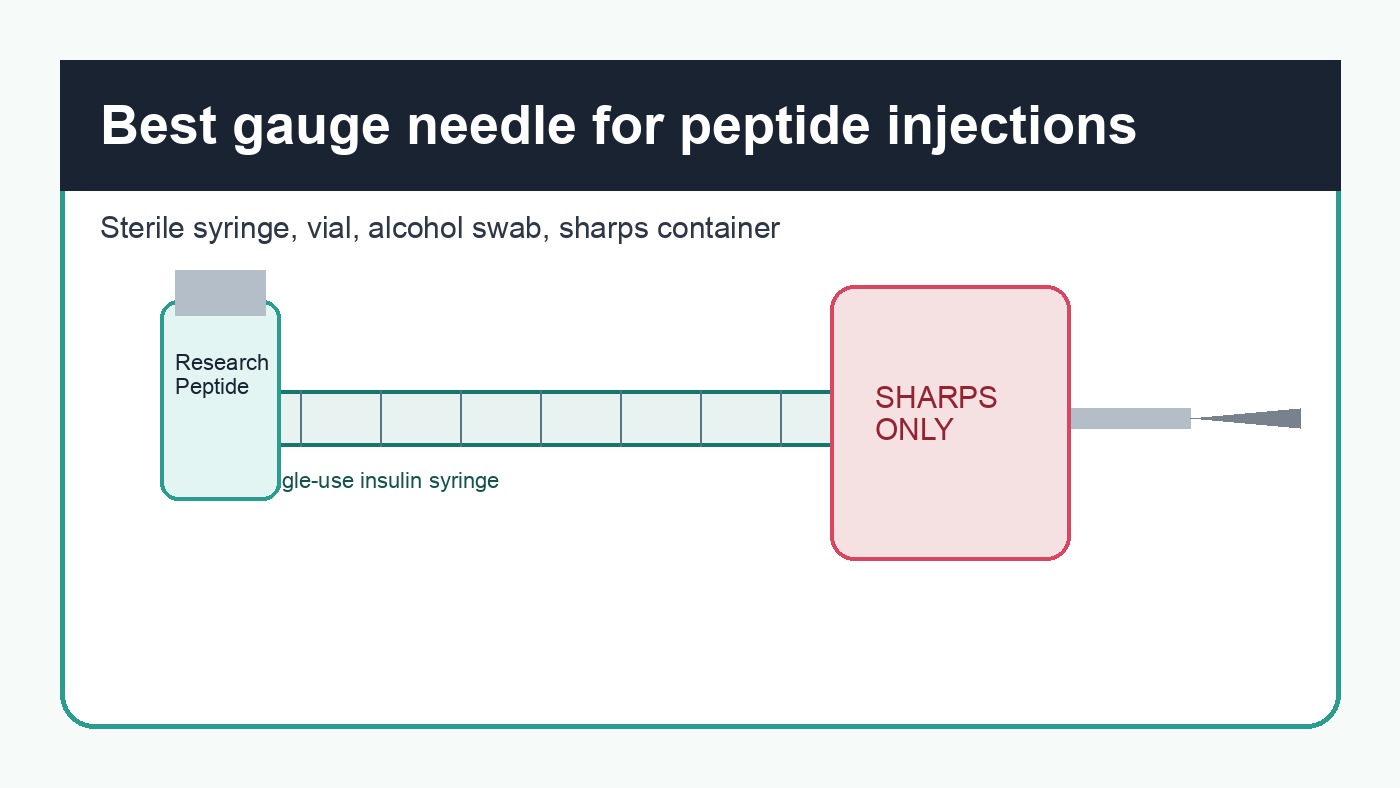
Best gauge needle for peptide injections: quick answer
For subcutaneous peptide injections, the practical sweet spot is usually 30G x 5/16 inch or 30G x 1/2 inch. It is thin enough for a small puncture, wide enough to draw reconstituted liquid without much frustration, and common enough that most insulin syringe charts include it.
That does not make 30G perfect for every setup. Some people prefer 31G for smaller injection volumes because it feels finer. Others prefer 29G because a very thin needle can be slow when pulling liquid through a rubber stopper.
The honest answer is a range, not a single magic size. If a guide claims one needle is ideal for every peptide, every body type, and every route, that is too neat.
Need peptides in multiple delivery forms?
Limitless Biotech has one of the broadest research catalogs, including injectable, nasal spray, and capsule formats for many compounds.
118+ research peptides in injectable, spray, and capsule forms - create a free account to see the full catalog. Use code PeptidePick for a discount at checkout.
Best gauge needle for peptide injections by size
Needle gauge works backward. A higher gauge number means a thinner needle. So 31G is thinner than 30G, and 30G is thinner than 29G.
For subcutaneous injections, patient-facing medical resources commonly describe short needles in the 25G to 30G range. Peptide research users usually narrow that further to insulin syringes around 29G to 31G because reconstituted peptides are water-based and injected in small volumes.
| Needle size | Best fit | Tradeoff |
|---|---|---|
| 31G | Small-volume subcutaneous injections where comfort is the top concern | Can draw slowly, especially through firm vial stoppers |
| 30G | Best all-around option for most reconstituted peptide solutions | Still slower than wider medical needles |
| 29G | Easier drawing and a sturdier needle feel | Slightly larger puncture than 30G or 31G |
| 25G to 27G | Sometimes used to draw liquid or for routes outside standard subcutaneous use | Usually larger than needed for small subcutaneous peptide injections |
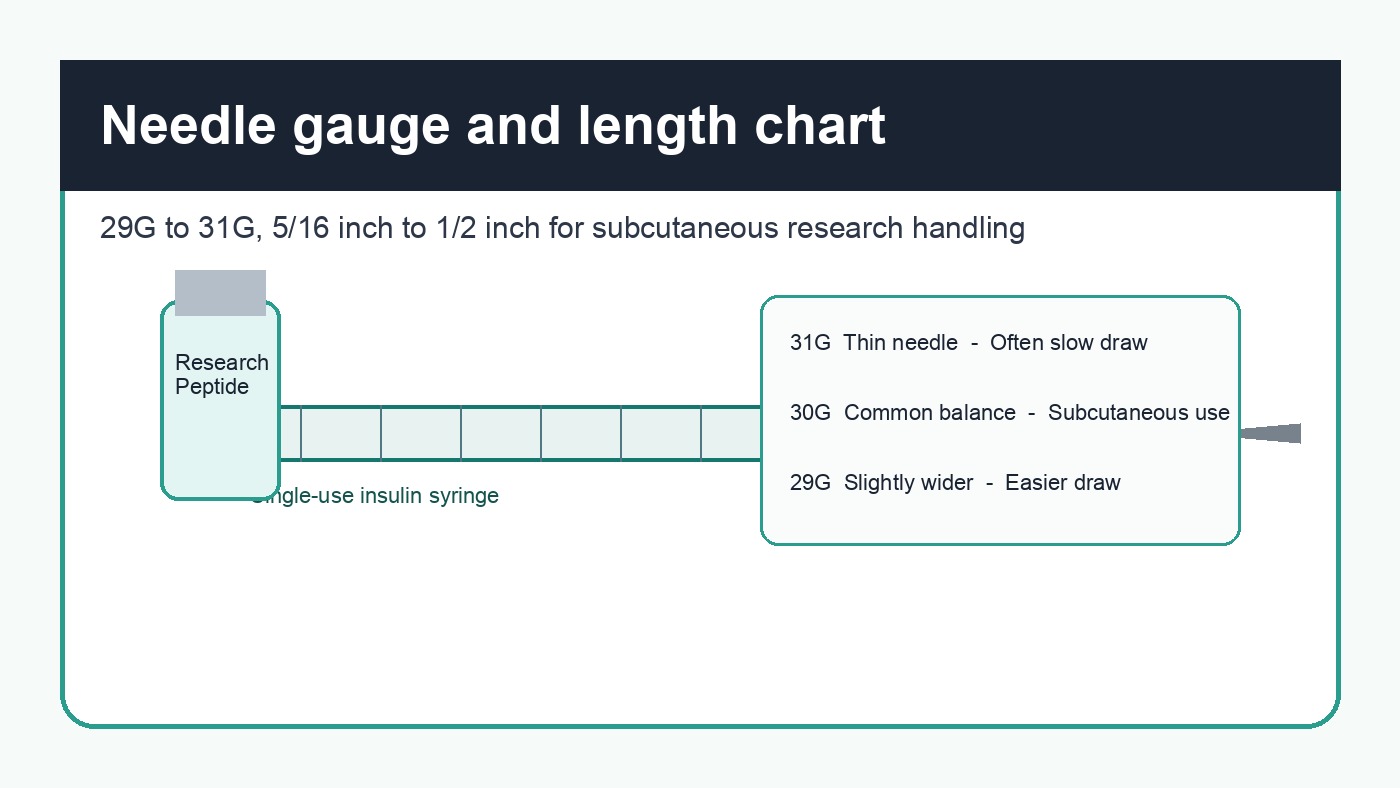
Insulin syringes are popular because the needle and barrel are already matched for small volumes. A 0.3 mL or 0.5 mL syringe can also make small unit markings easier to read than a larger 1 mL barrel.
If measuring units is the confusing part, use the mcg to insulin syringe conversion guide and the free peptide reconstitution calculator before handling any vial. Math mistakes are a bigger risk than choosing between 30G and 31G.
Needle length: 5/16 inch vs 1/2 inch
For subcutaneous injections, the goal is the fatty tissue under the skin, not the muscle. That is why short needles are common. The two sizes people compare most often are 5/16 inch, which is about 8 mm, and 1/2 inch, which is about 12.7 mm.
A 5/16 inch needle is often enough for abdominal or thigh subcutaneous injections when the skin is pinched and the injection angle is controlled. A 1/2 inch needle gives more reach but may need more attention in lean areas so it does not go deeper than intended.
Technique matters here. The same needle can behave differently depending on the angle, site, and amount of tissue pinched. That is one reason medical instructions often pair needle length with route and anatomy, rather than naming a size in isolation.
PeptidePick has a separate peptide injection site rotation chart that covers abdomen, thigh, and other common subcutaneous locations. Rotation matters because repeated injections in the same small area can irritate tissue.
Subcutaneous vs intramuscular peptide injections
Most research peptide discussions focus on subcutaneous injections. Intramuscular injections are different. They target muscle tissue, often require longer needles, and carry a different risk profile.
StatPearls describes intramuscular injections as medication placed into selected muscles with attention to landmarks and complications. That is not the same as a short insulin syringe placed into subcutaneous tissue.
This distinction gets blurred online. It should not. A 31G x 5/16 inch insulin syringe might make sense for a small subcutaneous injection, but it is not a universal tool for every injection route.
For peptide basics, read how to reconstitute peptides before choosing supplies. Reconstitution, sterility, and measurement all sit upstream of needle choice.
Comparing research peptide vendors?
Pinnacle Peptide Labs carries common research peptides, GLP research compounds, and pre-made stacks for readers comparing supply options.
Use code Peptidepick15 for 15% off your order
99% pure research peptides - use code Peptidepick15 for 15% off
Sterile handling matters more than tiny gauge differences
CDC injection safety guidance uses a simple rule: one needle, one syringe, only one time. That rule applies even if the needle still looks clean. Once a sterile needle has been used, it is contaminated.
Needle gauge does not fix poor handling. A perfect 30G syringe is still unsafe if it is reused, touched, stored open, or used to enter a vial after contact with skin.
- Use a new sterile syringe and needle every time.
- Clean the vial stopper and skin site with an alcohol swab.
- Let alcohol dry before inserting the needle.
- Do not touch the needle after removing the cap.
- Discard bent, dropped, or contaminated needles.
FDA sharps guidance recommends placing used needles and sharps into FDA-cleared sharps disposal containers immediately after use. If one is not available, FDA notes that some community guidelines allow a heavy-duty plastic household container with a tight, puncture-resistant lid.
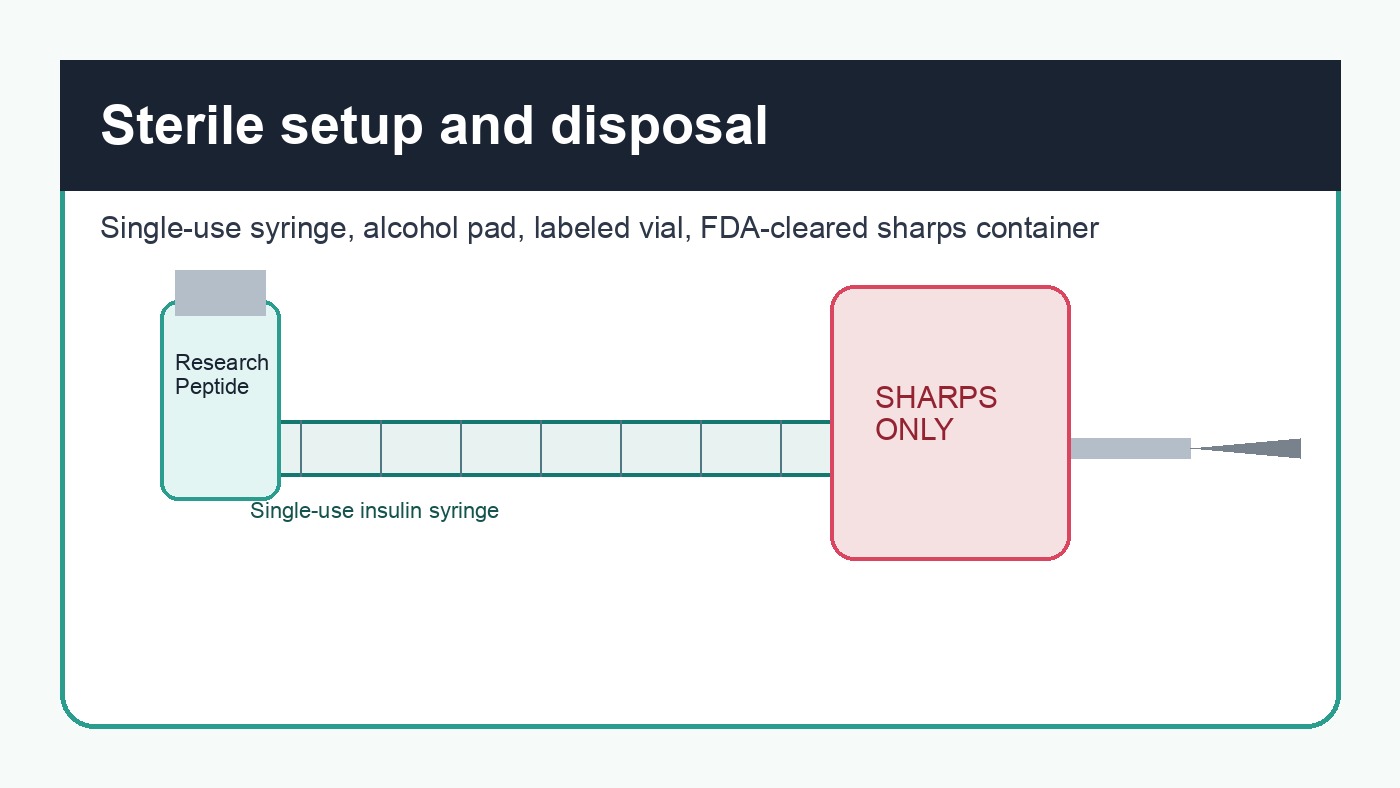
Do not overfill a sharps container. FDA says disposal should follow community rules when the container is about three-quarters full. Local rules vary, so check city, county, or pharmacy options before the container is full.
What to buy with research peptides
A basic subcutaneous research setup usually includes more than the peptide vial. It may include bacteriostatic water, alcohol swabs, insulin syringes, a sharps container, and a way to track reconstitution math.
For vendor comparison, see the best peptide companies guide. That page compares sourcing signals, catalog depth, testing claims, and research-use framing.
Some peptide vendors sell bacteriostatic water, but syringes and sharps containers are often purchased through pharmacies or medical supply channels. Keep those categories separate. A peptide vendor is not automatically the best place to buy injection supplies.
For readers who prefer non-injectable research-adjacent options, Nootropics Depot sells third-party tested oral supplements - no injections required. That is a supplement route, not an injectable peptide route.
Common needle size mistakes
The first mistake is using a needle that is too long for the intended subcutaneous site. A longer needle is not automatically better. It may simply increase the chance of going deeper than planned.
The second mistake is chasing the thinnest possible needle. A 31G needle can be comfortable, but it may draw slowly. If the process becomes awkward, people tend to rush, bend needles, or contaminate supplies.
The third mistake is ignoring syringe volume. A 1 mL syringe can work, but a smaller barrel may be easier to read for tiny volumes. That matters when peptides are measured in units after reconstitution.
There is also a quieter mistake: copying a needle size from a GLP-1 pen discussion and assuming it applies to every peptide vial. Pens, fixed-dose devices, and manually reconstituted research vials are different workflows.
Syringe volume matters too
Needle gauge gets most of the attention, but syringe volume can be just as practical. A 0.3 mL insulin syringe gives wider spacing between unit marks than a 1 mL syringe, so tiny measurements are easier to see. That can reduce handling time and hesitation.
For larger reconstitution volumes, the bigger barrel may be convenient. For small research aliquots, a smaller barrel often feels more controlled. The best setup is the one that lets the user read the markings clearly without rushing.
Dead space is another detail worth knowing. Fixed-needle insulin syringes often leave less residual liquid than detachable needle setups. The difference is small, but with expensive research materials, small losses still matter.
Best practical setup for most subcutaneous peptide research
If forced to pick one default, choose a 30G insulin syringe with a 5/16 inch needle for small subcutaneous injections. It is a reasonable balance between comfort, control, and draw speed.
If the solution is slow to draw, move to 29G. If the solution draws easily and comfort is the main concern, 31G may be fine. For larger volumes or non-subcutaneous routes, ask a clinician rather than guessing.
The needle is only one part of the protocol. Reconstitution math, sterile technique, site rotation, and disposal habits decide whether the setup is controlled or sloppy.
Need a broad third-party tested peptide catalog?
Ascension Peptides is a strong fit for recovery, cognitive, and general research categories where product variety matters.
60+ third-party tested research peptides and stacks
Research and safety sources
- CDC injection safety guidance: one needle, one syringe, only one time, plus aseptic preparation.
- FDA sharps disposal guidance: used sharps should go into FDA-cleared sharps containers immediately after use.
- FDA sharps container guidance: containers should be rigid, leak-resistant, upright, stable, labeled, and have a puncture-resistant lid.
- StatPearls intramuscular injection review: injection route changes the landmarks, needle requirements, and complication profile.
- Common patient education references describe subcutaneous injections as using short, small needles, often around 25G to 30G and roughly 1/2 to 5/8 inch depending on context.
Related articles
- Free peptide reconstitution calculator
- How to reconstitute peptides
- How to measure peptides in mcg
- Peptide injection site rotation chart
- Best peptide companies
- Bacteriostatic water for peptides
FAQ
What is the best gauge needle for peptide injections?
The best gauge needle for peptide injections is usually 30G for subcutaneous use. It balances comfort and draw speed better than most sizes. Some users prefer 31G for comfort or 29G for easier drawing.
Is 31G better than 30G for peptides?
31G is thinner than 30G, so it may feel gentler. But it can draw liquid more slowly. For many reconstituted peptides, 30G is the easier all-around choice.
What needle length is best for subcutaneous peptide injections?
Common short lengths are 5/16 inch and 1/2 inch. A 5/16 inch needle is often enough for subcutaneous abdominal or thigh injections when technique is controlled. A clinician can give route-specific guidance.
Can peptide needles be reused?
No. CDC injection safety guidance supports single use: one needle, one syringe, only one time. Used needles should go directly into a sharps container.
Do peptides need intramuscular needles?
Many peptide discussions involve subcutaneous injections, not intramuscular injections. Intramuscular injections are a different route and may require different needle length, landmarks, and clinical supervision.
Where should used peptide needles go?
FDA recommends placing used needles and sharps in FDA-cleared sharps disposal containers immediately after use. Disposal rules vary by location, so follow local community guidance when the container is about three-quarters full.
Affiliate disclosure: PeptidePick may earn a commission if you buy through links on this page. This does not change our editorial standards. Product mentions are for research-use discussion only, and peptides are not intended to diagnose, treat, cure, or prevent disease.