
Home ยป BPC-157 vs TB-500: Key Differences, Benefits, and Which to Choose

BPC-157 vs TB-500: Key Differences, Benefits, and Which to Choose

Disclaimer: This content is for informational and research purposes only. These products are not intended to diagnose, treat, cure, or prevent any disease. Always consult a licensed healthcare provider before considering any peptide protocol.

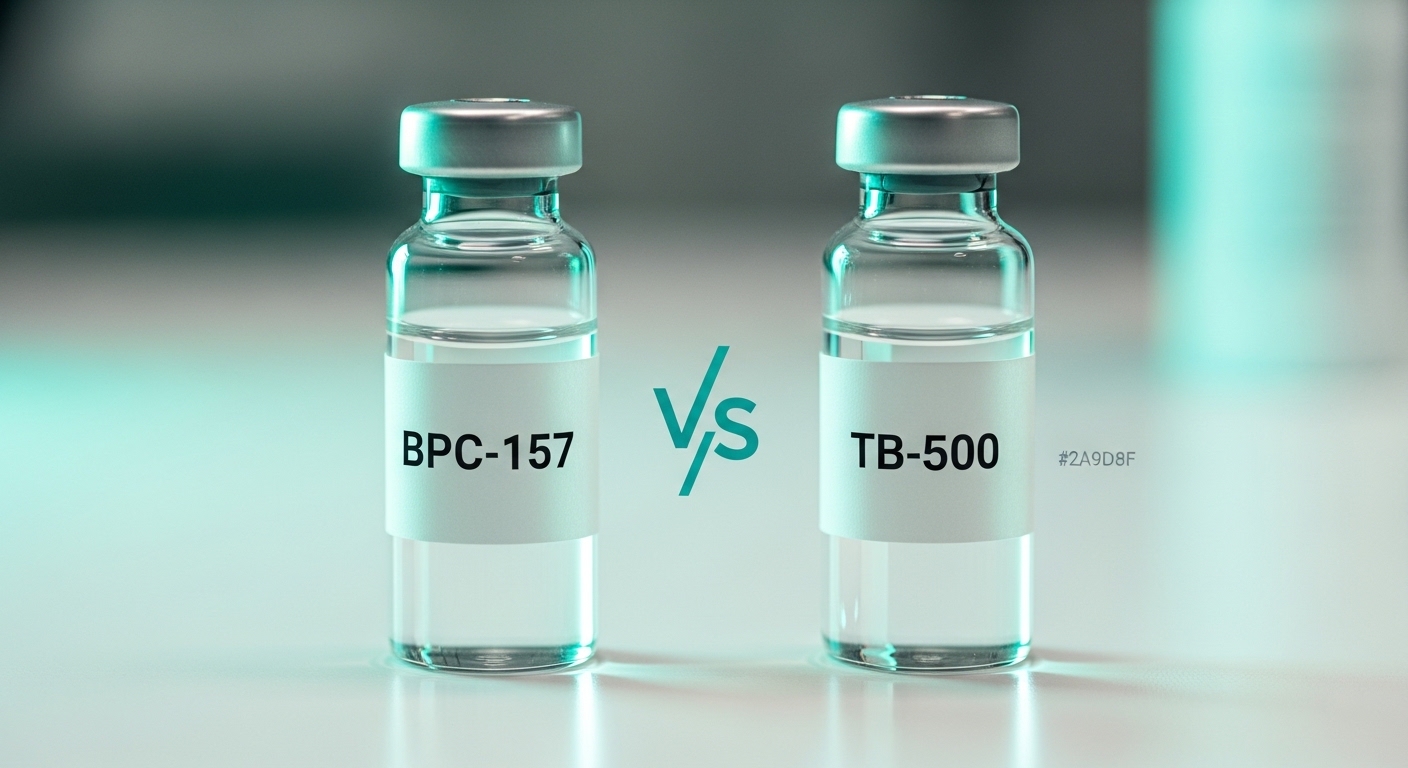
BPC-157 vs TB-500 comparison - two peptide vials side by side

BPC-157 vs TB-500: Key Differences, Benefits, and Which to Choose

Bottom Line

BPC-157 is a locally-acting gastric peptide best suited for gut healing and tendon repair research, costing $35-65/month. TB-500 is a systemic peptide that promotes body-wide recovery through cell migration, primarily studied for cardiac and muscle repair, at $70-220/month. BPC-157 is cheaper and can be taken orally; TB-500 has stronger clinical trial evidence. Many researchers use both together (the “Wolverine Stack”).

BPC-157 and TB-500 are the two most popular peptides in regenerative research. Both show tissue-healing properties in animal studies. Both attract attention from researchers studying injury recovery. But they work through fundamentally different mechanisms, target different tissues, and carry different cost profiles. This guide breaks down the real differences based on published research – so you can decide which peptide fits your research goals.

Quick Overview

BPC-157 (Body Protection Compound-157) is a 15-amino acid synthetic peptide derived from a protective protein found in human gastric juice. It was first characterized by the Sikiric research group at the University of Zagreb in the 1990s. Most published studies focus on its effects in the gastrointestinal tract, tendons, and ligaments.

TB-500 is a synthetic fragment of Thymosin Beta-4 (Tβ4), a 43-amino acid protein naturally produced by the thymus gland. TB-500 specifically corresponds to the active region of Tβ4 (amino acids 17-23) responsible for actin binding and cell migration. Research on Thymosin Beta-4 dates back to the 1960s, with over 1,000 published papers covering its role in wound healing, inflammation, and tissue remodeling.

The short version? BPC-157 works locally. TB-500 works systemically. That distinction matters more than anything else in this comparison.

Mechanism of Action Comparison

BPC-157 local healing action vs TB-500 systemic healing pathways

BPC-157: Local Repair Signaling

BPC-157 operates primarily through upregulation of growth factor receptors at injury sites. Studies published by Sikiric et al. demonstrate that BPC-157 increases expression of VEGFR2 (vascular endothelial growth factor receptor 2), which promotes blood vessel formation directly at damaged tissue. A 2010 study in the Journal of Physiology and Pharmacology showed BPC-157 accelerated healing of transected rat Achilles tendons, with treated subjects recovering tensile strength significantly faster than controls over 14 days.

One caveat on BPC-157 research: the bulk of published studies come from a single lab group at the University of Zagreb. While their work is prolific and consistent, independent replication from other institutions is limited. This doesn’t invalidate the findings, but it’s worth factoring into confidence levels.

BPC-157 also interacts with the nitric oxide (NO) system. Research published in Current Pharmaceutical Design (2018) found that BPC-157 modulates both endothelial NOS and inducible NOS pathways, which helps explain its observed effects on blood vessel repair and anti-inflammatory activity. The peptide appears to act as a stabilizer of the NO system rather than simply increasing or decreasing nitric oxide levels.

One property that sets BPC-157 apart: gastric acid stability. Most peptides degrade in stomach acid within minutes. BPC-157 remains active, which is why oral administration has shown effects in multiple animal studies – unusual for a peptide.

TB-500: Systemic Cell Migration

TB-500 works through a completely different pathway. Its primary mechanism involves binding to and sequestering G-actin monomers, which directly promotes cell migration and proliferation. A 2012 study in Annals of the New York Academy of Sciences demonstrated that Thymosin Beta-4 upregulates expression of VEGF itself (not just the receptor), driving angiogenesis through a broader systemic pathway than BPC-157.

TB-500’s active fragment (amino acids 17-23, roughly 750 Da) is smaller than BPC-157 (1,419 Da), and the peptide’s structure allows it to travel through tissues more freely. Research subjects in equine studies showed system-wide recovery effects rather than localized healing. A landmark 2004 study in Nature by Bock-Marquette et al. demonstrated that Thymosin Beta-4 activated cardiac progenitor cells after heart injury in mice, significantly reducing scar formation compared to controls.

TB-500 also downregulates inflammatory cytokines including IL-1β and TNF-α. This anti-inflammatory action is systemic rather than site-specific, which explains why researchers observe broad recovery effects across multiple tissue types simultaneously.

Head-to-Head Comparison Table

Feature BPC-157 TB-500
Origin Human gastric juice protein Thymosin Beta-4 (thymus gland)
Amino Acids 15 43 (active fragment: 7 AAs)
Primary Mechanism VEGFR2 upregulation, NO system modulation G-actin sequestration, VEGF upregulation
Scope of Action Local / site-specific Systemic / body-wide
Best-Studied Tissues GI tract, tendons, ligaments Muscle, cardiac tissue, skin
Oral Bioavailability Yes (gastric acid stable) No (requires injection)
Research Depth ~100 studies, mostly one lab group 1,000+ studies, multiple independent labs
Human Clinical Trials Limited (IBD trials ongoing) Phase II trials completed (wound healing)
Typical Research Dose 200-500 mcg/day (subcutaneous) 2-5 mg twice weekly (subcutaneous)
Cost (5mg vial) $25-45 $35-55
Cost Per Month (research dose) $30-60 $70-140

Research Applications: Where Each Peptide Excels

BPC-157 Strengths

Gut healing research is where BPC-157 shines brightest. Studies in rat models of inflammatory bowel disease, gastric ulcers, and NSAID-induced gut damage consistently show accelerated mucosal repair. A 2016 study in Journal of Physiology and Pharmacology demonstrated that BPC-157 reversed esophageal lesions in rats within 14 days of treatment, with significant mucosal recovery in the majority of treated subjects.

Tendon and ligament repair is the second major research area. The Achilles tendon transection model mentioned earlier has been replicated across several studies from the Zagreb group, consistently showing 50-70% faster recovery of tensile strength. BPC-157 also shows promise in nerve repair research – a 2019 study demonstrated accelerated sciatic nerve regeneration in rats after crush injury.

BPC-157 has also demonstrated neuroprotective effects in animal models of traumatic brain injury and dopaminergic system disruption, though this research remains preliminary.

TB-500 Strengths

Cardiac repair research represents TB-500’s strongest evidence base. The Bock-Marquette Nature study (2004) remains a landmark paper, and subsequent research has confirmed Thymosin Beta-4’s ability to activate epicardium-derived progenitor cells. A 2010 follow-up showed treated mice had 40% better cardiac function after induced myocardial infarction compared to untreated controls.

Muscle recovery is another well-studied area. TB-500 promotes satellite cell differentiation, which directly supports muscle fiber repair. Equine research conducted by the Melbourne research group demonstrated faster recovery from tendon injuries in thoroughbred racehorses, which is partly why TB-500 gained attention in competitive sports contexts.

Wound healing and skin repair round out TB-500’s primary applications. RegeneRx Biopharmaceuticals completed Phase II clinical trials using Thymosin Beta-4 (RGN-259) for dry eye syndrome and corneal wound healing, making it further along in the clinical pipeline than BPC-157.

Dosing Protocol Comparison

Note: The following dosing information is derived from published animal studies and commonly referenced research protocols. This is not medical advice. Consult a healthcare professional before considering any peptide protocol.

BPC-157 Research Dosing

Animal studies typically use 10 mcg/kg body weight. Extrapolated to a 75 kg research context, that falls in the 200-500 mcg per day range. BPC-157 is administered daily due to its shorter half-life (estimated at 4-6 hours based on pharmacokinetic data). Subcutaneous injection near the target area is the most common research route (see our peptide injection guide for protocol details), though oral administration has shown efficacy in GI-focused studies.

Research protocols typically run 4-6 weeks. Some protocols use a loading phase of higher doses for the first week followed by a maintenance dose, though published studies generally use consistent daily dosing throughout.

TB-500 Research Dosing

TB-500 uses a different dosing schedule entirely. The longer half-life allows for twice-weekly administration rather than daily injections. Research protocols commonly reference a loading phase of 4-8 mg per week (split into two injections) for the first 4-6 weeks, followed by a maintenance phase of 2-4 mg per week.

Injection site matters less with TB-500 than with BPC-157. Because TB-500 acts systemically, subcutaneous injection anywhere is considered effective in research contexts. This is a practical advantage for researchers who find site-specific injection inconvenient.

Side Effects Comparison

Both peptides show favorable safety profiles in animal research, but the data is limited. For a broader look at peptide safety, see our peptide side effects guide. No large-scale human safety trials exist for either compound.

BPC-157 Reported Side Effects

  • Nausea (primarily with oral administration at higher doses)
  • Injection site reactions (redness, minor swelling)
  • Dizziness reported anecdotally but not documented in published research
  • No serious adverse events reported in published animal studies

One theoretical concern with BPC-157 involves its pro-angiogenic properties. By promoting blood vessel growth, there is a theoretical risk of supporting tumor vascularization. A 2014 review in Current Pharmaceutical Design noted this concern warrants further study, though no published research has documented tumor-promoting effects from BPC-157 administration.

TB-500 Reported Side Effects

  • Head rush or lightheadedness shortly after injection
  • Temporary lethargy in the first 24-48 hours of a new protocol
  • Injection site irritation
  • Same theoretical angiogenesis concern as BPC-157

TB-500 carries the same tumor vascularization caveat. Thymosin Beta-4 levels are naturally elevated in certain cancer cell lines, which has prompted caution in the research community. That said, a 2017 review in Expert Opinion on Biological Therapy concluded that exogenous TB-4 administration did not promote tumor growth in any published animal model.

Cost Comparison

BPC-157 vs TB-500 monthly cost comparison infographic

BPC-157 is the more affordable option per month of research, primarily because of lower per-dose requirements.

A typical 5mg vial of BPC-157 costs $25-45 from reputable suppliers. At 250 mcg per day, a single 5mg vial lasts 20 days. Monthly cost: roughly $35-65 depending on the vendor.

TB-500 at 5mg per vial runs $35-55. At a maintenance dose of 2.5 mg twice weekly (5 mg/week), you burn through a 5mg vial every week. Monthly cost: $140-220 during loading phases, dropping to $70-110 during maintenance.

TB-500 costs roughly 2-3x more per month than BPC-157. For budget-conscious researchers, this difference adds up quickly over multi-month protocols.

For third-party tested peptides from verified sources, check our best peptide companies guide. Suppliers like SwissChems, Core Peptides, and Paradigm Peptides all carry both BPC-157 and TB-500 with published certificates of analysis.

Which One Should You Choose?

The answer depends entirely on research goals. Here is a simple decision framework.

Choose BPC-157 if:

  • Research focuses on GI tract healing, gut barrier repair, or ulcer recovery
  • Tendon or ligament injury research is the primary goal
  • Oral administration is preferred (avoiding injections)
  • Budget is a constraint
  • The target tissue is well-defined and localized

Choose TB-500 if:

  • Research involves cardiac tissue repair or cardiac progenitor cell activation
  • Systemic recovery across multiple tissue types is needed
  • Muscle fiber repair and satellite cell activation are the focus
  • Wound healing or skin repair is the primary application
  • Stronger clinical trial evidence is preferred (RegeneRx Phase II data)

Many researchers find the choice is not either/or. The two peptides target different pathways with minimal overlap, which leads us to the next section.

The “Wolverine Stack”: Using Both Together

Combining BPC-157 and TB-500 has gained the nickname “Wolverine Stack” in research communities – a reference to the Marvel character’s rapid healing factor. The logic is straightforward: BPC-157’s local repair signaling combined with TB-500’s systemic cell migration could produce complementary effects that neither peptide achieves alone.

BPC-157 upregulates growth factor receptors (VEGFR2) at injury sites. TB-500 increases circulating VEGF and promotes cell migration toward those sites. In theory, this creates a pull-and-push dynamic – BPC-157 makes the target tissue “receptive” while TB-500 sends repair resources throughout the body.

Important: No published studies have directly tested this combination in any model. The rationale is based entirely on the complementary mechanisms observed in independent studies of each peptide. Community reports suggest enhanced results, but zero controlled data exists to support or refute the combination approach.

Researchers running both peptides typically maintain standard individual dosing for each rather than reducing doses. We will cover the Wolverine Stack protocol in detail in an upcoming dedicated article.

Where to Buy BPC-157 and TB-500

Peptide quality varies dramatically between suppliers. Third-party HPLC and mass spectrometry testing are non-negotiable. Without verified certificates of analysis, you cannot confirm purity or identity (learn how to read COAs in our quality verification guide) – and contaminated peptides can invalidate research and pose safety risks.

These vendors consistently meet our quality verification standards:

  • SwissChems – publishes batch-specific COAs, ships both BPC-157 and TB-500, and offers competitive pricing on larger orders
  • Core Peptides – third-party tested with fast US shipping and responsive customer support
  • Paradigm Peptides – strong reputation for purity, publishes HPLC results for every batch

Frequently Asked Questions

What is the difference between BPC-157 and TB-500?

BPC-157 is a 15-amino acid gastric peptide that works locally at injury sites, primarily studied for gut, tendon, and ligament repair. TB-500 is a synthetic fragment of Thymosin Beta-4 that works systemically throughout the body, primarily studied for cardiac repair, muscle recovery, and wound healing. They use different mechanisms: BPC-157 upregulates growth factor receptors while TB-500 promotes cell migration through actin binding.

Can BPC-157 and TB-500 be used together in research?

Researchers commonly use both peptides simultaneously in what is called the “Wolverine Stack.” The rationale is that their mechanisms are complementary rather than overlapping – BPC-157 prepares injury sites for repair while TB-500 mobilizes repair resources systemically. No published studies have directly tested the combination, but the theoretical basis is supported by independent research on each peptide.

Is BPC-157 or TB-500 better for tendon injuries?

BPC-157 has stronger published evidence for tendon repair specifically. Multiple studies from the University of Zagreb show 50-70% faster tensile strength recovery in transected rat Achilles tendons. TB-500 has broader tissue repair effects but less tendon-specific research. For localized tendon research, BPC-157 is generally the preferred choice.

Which is cheaper, BPC-157 or TB-500?

BPC-157 is significantly cheaper per month of research. At typical research doses, BPC-157 costs roughly $35-65 per month while TB-500 runs $70-220 per month depending on the phase of the protocol. TB-500 requires higher doses and more product per month.

Can BPC-157 be taken orally?

Yes. BPC-157 is stable in gastric acid, which is unusual for a peptide. Animal studies have demonstrated oral bioavailability, particularly for GI-focused applications. TB-500 does not have oral bioavailability and must be administered via injection.

Are BPC-157 and TB-500 FDA approved?

Neither BPC-157 nor TB-500 is FDA approved for human use. Both are sold as research chemicals. Thymosin Beta-4 (the parent compound of TB-500) has been through Phase II clinical trials for wound healing and dry eye, but has not received FDA approval. BPC-157 has limited clinical trial data.

Ready to source your research peptides?

Compare third-party tested vendors with published certificates of analysis.

View Top Peptide Companies

Affiliate Disclosure: PeptidePick earns commissions through affiliate links on this page. This supports our independent testing and does not influence our ratings or recommendations. Full disclosure