
Vendor shortcuts
Compare the right source before you keep reading
Pick the lane that matches your research goal, then verify current COAs, label language, and shipping policy on the vendor page.
Research-only affiliate links. PeptidePick may earn a commission at no extra cost to you.
Compounded Semaglutide vs Ozempic: What Actually Changes?
TL;DR
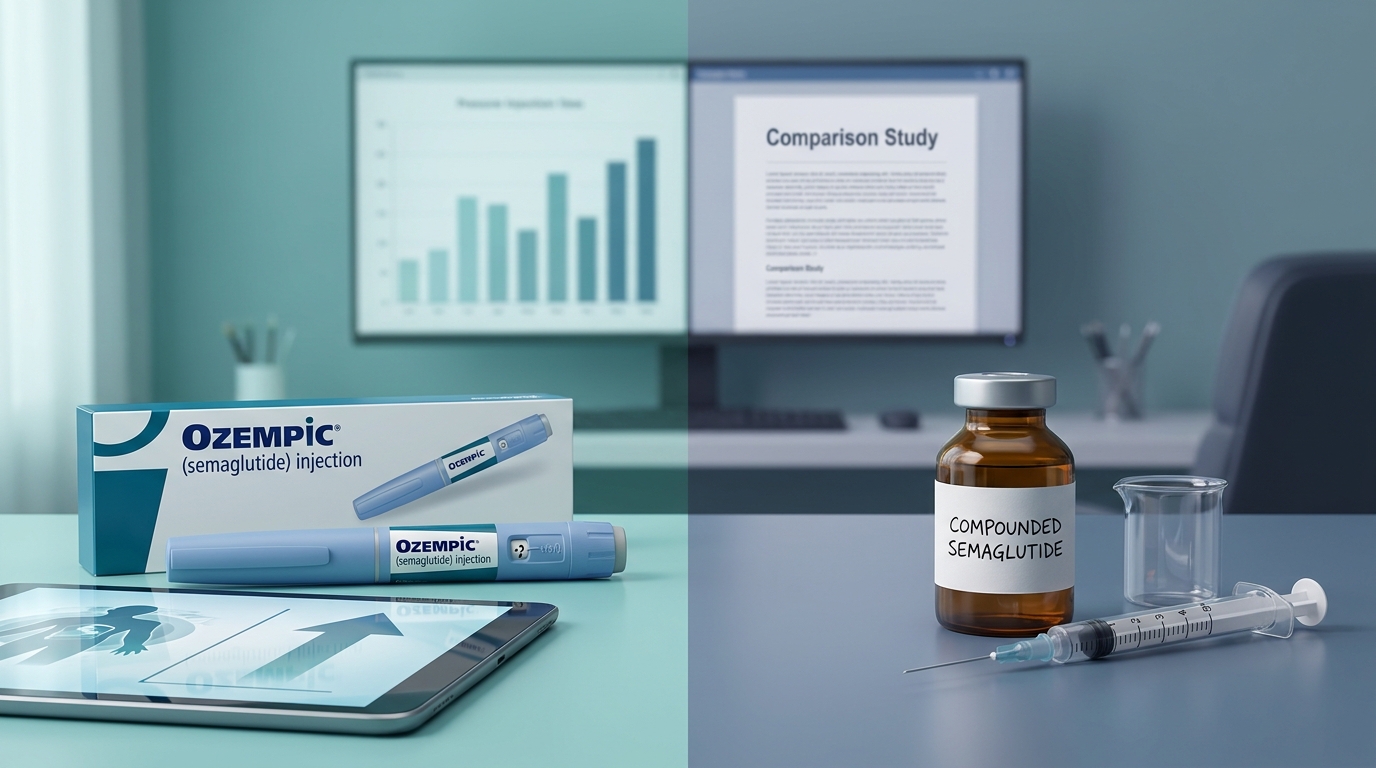
Compounded semaglutide vs Ozempic is not a close apples-to-apples comparison. Ozempic is an FDA-approved semaglutide injection with standardized manufacturing, labeled dosing, and known safety warnings. Compounded semaglutide is custom mixed by a pharmacy, is not FDA approved, and can carry extra quality and sourcing risk.
That does not make every compounded product automatically illegitimate. But after the FDA declared the semaglutide shortage resolved in February 2025, the legal room for routine copycat compounding narrowed fast. For most readers, the real question is not which one is "stronger." It is which one has clearer oversight, cleaner supply chain visibility, and less uncertainty.
Compounded semaglutide vs Ozempic: quick answer
Ozempic is a branded, FDA-approved semaglutide injection made by Novo Nordisk for adults with type 2 diabetes, with added cardiovascular and kidney-related label claims in qualifying patients. Compounded semaglutide is a pharmacy-prepared version that does not go through the FDA approval process for safety, effectiveness, or manufacturing consistency.
That difference matters more than marketing copy. FDA-approved drugs are reviewed for identity, potency, labeling, sterility controls, and adverse-event reporting pathways. Compounded products operate under a different framework, and the FDA has repeatedly warned that some compounded semaglutide products may use salt forms such as semaglutide sodium or semaglutide acetate, not the same active ingredient used in approved products.
If you want the broader market context, this fits into the same category of questions covered in our peptides for weight loss guide and our comparison on tirzepatide vs semaglutide. But compounded semaglutide vs Ozempic is more of a regulation and quality-control issue than a simple performance contest.
Looking for semaglutide research options beyond a single branded product?
Apollo focuses heavily on GLP-1 research peptides and related weight-management compounds.
Shop Apollo Peptide Sciences →
Specializing in GLP-1 research peptides and growth factors
What Ozempic is and what compounded semaglutide is
Ozempic contains semaglutide in a finished commercial product with fixed strengths, labeled titration, manufacturer testing, and approved prescribing information. It sits in the same family as Wegovy and Rybelsus, though the approved uses are not identical. That distinction trips people up all the time.
Compounded semaglutide usually refers to a semaglutide-containing preparation mixed by a compounding pharmacy or outsourcing facility. In some cases, compounding is allowed for patient-specific reasons. In shortage periods, some compounders also produced versions that functioned as substitutes while approved supply remained constrained.
But there is a catch. After the shortage eased, the default assumption changed. A compounder generally cannot just keep producing what is essentially a copy of a commercially available drug unless statutory conditions are met.
| Category | Ozempic | Compounded semaglutide |
|---|---|---|
| FDA approval | Yes | No |
| Manufacturing consistency | Standardized commercial manufacturing | Varies by compounder and ingredient source |
| Labeling and dosing | Fixed branded labeling | May vary by pharmacy and formula |
| Shortage-era role | Official approved supply | Alternative used during shortage periods |
| Main concern | Known label warnings and GI side effects | Extra uncertainty around identity, purity, and legal status |
Compounded semaglutide vs Ozempic in FDA and legal terms
The FDA announced on February 21, 2025 that the shortage of semaglutide injection products was resolved. The agency then gave a short enforcement-discretion runway, ending April 22, 2025 for many 503A compounders and May 22, 2025 for many 503B outsourcing facilities tied to shortage-based exceptions.
That timeline changed the whole conversation. Before that point, many articles framed compounded semaglutide as a practical workaround to an ugly supply crunch. After that point, the question became whether a compounded product was legally justified for a specific patient need, or whether it looked like an ordinary copy of a commercially available drug.
FDA also clarified that semaglutide and tirzepatide do not appear on the 503B bulks list and do not currently appear on the drug shortage list. It further explained that combinations such as semaglutide plus vitamin B12 can still be treated as essentially a copy if they are similar enough in strength and route of administration. That shuts down one of the more common sales angles readers still see online.
- Key point: shortage-based flexibility narrowed sharply after February 2025.
- Key point: a patient-specific documented difference matters more than generic convenience.
- Key point: adding another ingredient does not automatically create a legally distinct product.
So if you are comparing compounded semaglutide vs Ozempic in 2026, start with the legal and quality framework first. Price alone is too shallow.
Effectiveness and safety differences are where the gap gets real
The strongest semaglutide efficacy data comes from FDA-reviewed commercial products, not from broad randomized trials on compounded versions. In STEP 1, adults with overweight or obesity who received once-weekly semaglutide 2.4 mg plus lifestyle intervention lost about 14.9% of body weight over 68 weeks, versus 2.4% with placebo. That study is one reason semaglutide became such a massive category.
Ozempic itself is not approved for weight loss, even though semaglutide as a molecule clearly has weight-loss data in the broader literature. That nuance matters. Wegovy carries the weight-management approval, while Ozempic is approved for type 2 diabetes and selected cardiovascular and kidney risk reductions in qualifying patients.
Compounded semaglutide may still contain semaglutide. But the problem is not theoretical receptor binding. The problem is whether the finished product matches the expected ingredient form, concentration, sterility, and dosing accuracy of the approved reference product.
FDA has flagged reports involving compounded products that may contain semaglutide salt forms such as semaglutide sodium or semaglutide acetate. The agency has said it is not aware of a lawful basis for compounding with those salt forms when the approved products use semaglutide base. That is a major distinction, not paperwork trivia.
Want broader access to GLP-1 and metabolic research products?
Limitless stands out for catalog depth and multiple delivery formats, but the VIP signup link matters most because it locks in affiliate tracking first.
118+ research peptides in injectable, spray, and capsule forms - create a free account to access the full catalog
Create your free account first, then use code PeptidePick for a discount at checkout
Shared side effects do not mean shared confidence level
Both approved semaglutide products and compounded versions are commonly discussed in relation to nausea, vomiting, diarrhea, constipation, delayed gastric emptying, and gallbladder issues. But the safety conversation changes when the product itself has not been FDA reviewed.
For Ozempic, you at least know the labeled warnings, approved formulation, and manufacturing chain. With compounded semaglutide, one extra layer of uncertainty shows up before the medication even reaches the body.
Was the concentration correct? Was the active ingredient the right form? Was the sterile handling tight? Those are not abstract questions.
And there is a more uncomfortable point here. Some telehealth and med-spa marketing blurred the line between approved branded semaglutide and compounded substitutes during the shortage years. That made patient comparison shopping harder than it should have been.
Cost and access: why people still compare compounded semaglutide vs Ozempic
Cost drove much of the compounded semaglutide boom. Brand-name GLP-1 drugs are expensive, coverage can be patchy, and cash-pay patients often got pushed toward compounded alternatives because the monthly number looked easier to stomach.
That price gap is real. But the cheaper option can stop looking cheap if sourcing is shaky, the formulation is inconsistent, or a patient has to switch again because availability rules changed. A lower sticker price does not cancel out supply-chain opacity.
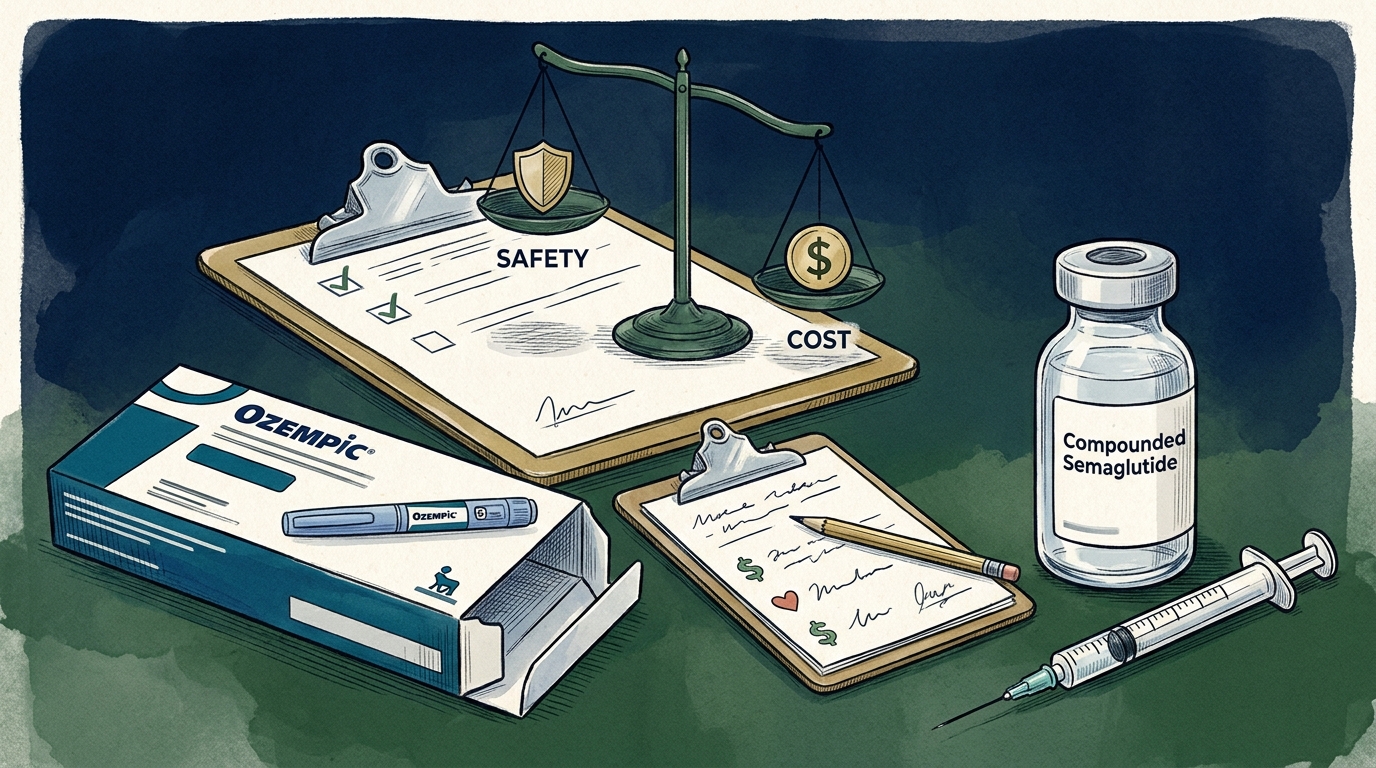
So the real decision usually comes down to these tradeoffs:
- Higher confidence in identity and oversight with Ozempic
- Historically lower upfront cost with many compounded offers
- Much less regulatory certainty for routine compounded-copy use after the shortage resolution
- More room for sales-page confusion in compounded channels
If you want a wider view of pricing pressure across the category, our peptide therapy cost breakdown and best peptides for weight loss rankings help frame why GLP-1 demand exploded in the first place.

How to evaluate a source carefully
If you are still looking at compounded semaglutide, ask better questions than "is it the same as Ozempic?" It usually is not the same product in regulatory terms, and that is the part that matters most.
Use this checklist:
- Is the pharmacy state licensed or the facility FDA registered where applicable?
- Is the product described clearly as compounded and not FDA approved?
- Is the active ingredient identified in a way that matches semaglutide base, not a salt form?
- Is there a legitimate patient-specific rationale, rather than a vague mass-market workaround?
- Does the seller avoid implying that compounded and approved branded products are interchangeable?
And yes, there is still some gray area in how individual prescribers and pharmacies handle edge cases. I would be cautious about anyone who pretends there is zero ambiguity here. But broad casual copycat compounding is on much shakier ground than it was during the peak shortage window.
For practical basics on storage, dosing math, and injection prep, use our free peptide reconstitution calculator, how to reconstitute peptides guide, how to inject peptides guide, and peptide storage guide. If you are comparing vendors more broadly, read our text review of the best peptide companies.
Need another GLP-1 research source to compare against Apollo and Limitless?
Pinnacle covers several GLP-category compounds and makes the discount angle straightforward.
99% pure research peptides - use code Peptidepick15 for 15% off
Use code Peptidepick15 for 15% off your order
Bottom line on compounded semaglutide vs Ozempic
Ozempic wins on regulatory clarity, manufacturing consistency, and evidence quality around the finished product. Compounded semaglutide mainly entered the conversation because approved supply broke down and prices stayed brutal.
In 2026, the comparison is less favorable to routine compounded copies than it looked in 2023 or early 2024. FDA-approved supply has stabilized, the shortage exception window closed, and regulators have said plainly that some compounded semaglutide products raise concerns about ingredient form and copycat status.
That does not mean every compounded prescription is automatically improper. But anyone presenting compounded semaglutide as a clean substitute for Ozempic, with no extra caveats, is skipping the most important part of the story.
If you want to keep comparing newer metabolic compounds, the next useful reads are retatrutide vs semaglutide, tirzepatide dosage guide, and our semaglutide guide.
FAQ
Is compounded semaglutide the same as Ozempic?
No. Both may involve semaglutide, but Ozempic is FDA approved and commercially manufactured, while compounded semaglutide is not FDA approved and may vary in formulation and oversight.
Did the FDA end the semaglutide shortage?
Yes. The FDA announced in February 2025 that the semaglutide injection shortage was resolved, then phased out shortage-related enforcement discretion for many compounders over the following months.
Why did people use compounded semaglutide in the first place?
Mainly because brand-name supply was tight and prices were high. Compounded products were marketed as alternatives during the shortage period.
Can compounded semaglutide contain a different ingredient form?
Yes, that is one of the FDA concerns. The agency has warned about compounded products using semaglutide salt forms such as semaglutide sodium or semaglutide acetate instead of the base used in approved products.
Is Ozempic approved for weight loss?
No. Ozempic is approved for type 2 diabetes and certain cardiovascular and kidney-related outcomes in qualifying adults. Wegovy, which also contains semaglutide, carries the dedicated weight-management approval.
What is the safest way to compare semaglutide options?
Start with regulatory status, ingredient form, pharmacy legitimacy, and whether the product is clearly presented as compounded rather than branded. Then compare cost and availability.
Related articles
- Peptides for Weight Loss: Research Compounds vs FDA-Approved Options
- Tirzepatide vs Semaglutide: A Research-Based Comparison of Two GLP Peptides
- Retatrutide vs Semaglutide: Comparing Weight Loss Peptides
- Semaglutide Guide: Research Overview and Sources
- Peptide Therapy Cost: What Research Peptides Actually Cost in 2025
- Best Peptides for Weight Loss: Ranked by Research Strength