
FDA Disclaimer: Dihexa is an unscheduled research compound. It has not been evaluated by the FDA for safety, efficacy, or medical use in humans. This content is not intended to diagnose, treat, cure, or prevent any disease.
All content on this page is for informational and educational purposes only. Nothing here constitutes medical advice. Consult a licensed physician before making any decisions about health, supplements, or research compounds.
Dihexa Peptide: The Nootropic Research Compound Explained
TLDR Summary
Dihexa (N-hexanoic-Tyr-Ile-(6)-aminohexanoic amide) is a synthetic peptide derived from angiotensin IV. Preclinical studies in rodents showed it enhanced memory and promoted synaptogenesis via HGF/c-Met signaling - but those studies have faced serious credibility problems.
The core 2014 paper was retracted in 2025. No human clinical trials exist. Researchers continue to study the angiotensin IV pathway, but dihexa's efficacy and safety in humans is entirely unknown.
Table of Contents
- What Is Dihexa?
- Mechanism of Action: HGF/c-Met Signaling
- What the Research Actually Shows
- The Retraction: What Happened to the Key Study
- Delivery Methods: Oral, Injectable, and Nasal Spray
- Dosage in Preclinical Research
- Safety Profile and Side Effects
- Legal and Regulatory Status
- Dihexa vs Semax vs Selank
- Research Sourcing Options
- FAQ
What Is Dihexa?
Dihexa peptide is a synthetic heptapeptide with the full chemical name N-hexanoic-tyrosine-isoleucine-(6)-aminohexanoic amide. It was originally developed at Washington State University by researchers studying the brain renin-angiotensin system - specifically, how fragments of angiotensin IV behave when they cross the blood-brain barrier.
The angiotensin IV fragment (Ang IV, also called angiotensin 3-8) had shown procognitive properties in earlier rodent studies. The problem was it couldn't cross the blood-brain barrier efficiently, and it broke down too quickly. Dihexa was designed to solve both problems - a more stable, lipophilic analog that could reach the brain after oral dosing.
That's the origin. Whether those properties translate to meaningful effects in humans is a separate question, and one that remains unanswered.
Research-Grade Nootropic Peptides, Third-Party Tested
Ascension Peptides carries 60+ third-party tested research peptides - including cognitive peptides like Semax and Selank verified by independent labs.
60+ third-party tested research peptides and stacks
Mechanism of Action: HGF/c-Met Signaling
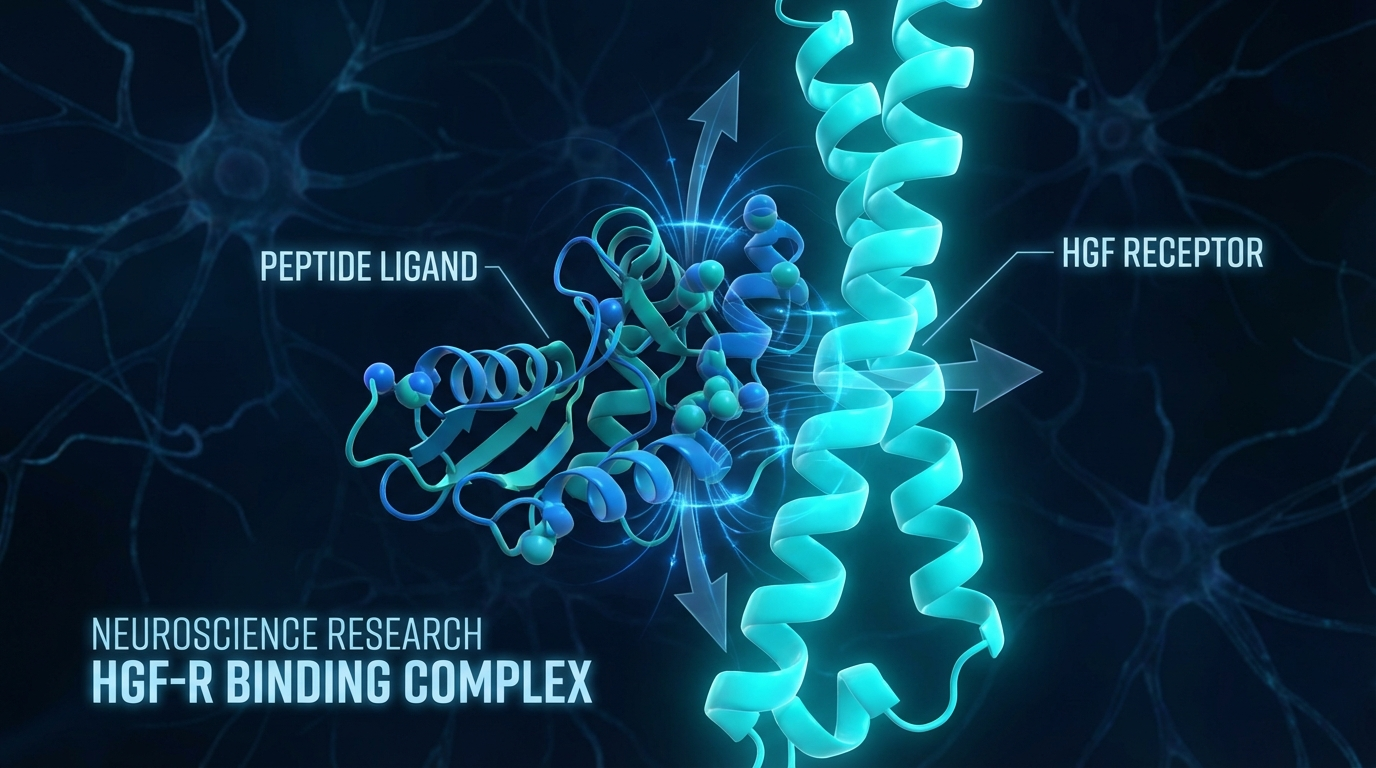
The proposed mechanism is specific. Dihexa is thought to bind to hepatocyte growth factor (HGF), potentiating its interaction with the c-Met receptor tyrosine kinase. When HGF binds c-Met at sufficient concentrations, it triggers downstream signaling cascades involved in cell survival, migration, and - in neurons - dendritic arborization and synapse formation.
The 2014 Benoist et al. study claimed dihexa could potentiate this pathway at subthreshold HGF concentrations - meaning even when HGF levels weren't high enough to activate c-Met on their own, dihexa could push the system over the threshold. This was the theoretical basis for the synaptogenesis and memory effects seen in rodent behavioral tests.
In principle, this is a plausible pathway. HGF/c-Met signaling is involved in brain development, and dysregulation has been documented in Alzheimer's disease models. The pathway is real. What's in question is whether dihexa activates it in the way the original researchers described.
The mechanism also differs from most nootropic peptides. Semax and Selank, for example, target BDNF, serotonin, and dopamine systems directly. Dihexa's proposed action on growth factor signaling is a distinct approach - which is part of why it attracted attention in the first place.
What the Research Actually Shows
The direct literature on dihexa is thin. By the time its key paper was retracted in 2025, there were fewer than five PubMed-indexed studies using dihexa specifically. The compound never progressed to Phase 1 human trials.
Here's what exists:
- Benoist et al. (2014), J Pharmacol Exp Ther 351(2):390-402 - The foundational dihexa study. Showed synaptogenesis and improved Morris water maze performance in scopolamine-impaired rats. This paper was retracted in April 2025 (PMID: 40312093) after a 2021 expression of concern.
- Ho & Nation (2018), Neurosci Biobehav Rev 92:209-225 - A systematic review of angiotensin IV and angiotensin-(1-7) cognition research. Reviewed 65+ preclinical studies. Found consistent evidence that angiotensin IV-related peptides improve memory in rodent models across several labs, though not all studies used dihexa specifically.
- Wells et al. (2024), J Huntingtons Dis 13(1):55-66 - Studied PNB-0408, a dihexa analog, in a rat model of Huntington's disease-like symptoms. Found improvements in motor coordination and reduced neuronal damage markers. This compound shares structural similarities with dihexa but is not identical.
What that picture adds up to: the angiotensin IV pathway has real preclinical support from multiple research groups. The specific dihexa data is weaker than the community assumed, partly because it was tied to a retracted study. The broader signaling pathway it supposedly targets remains scientifically valid and under active investigation.
No human data exists for dihexa. Zero clinical trials. The cognitive effects seen in rodent models have not been tested in any controlled human study.
For context on how peptides generally are studied and verified, see our guide on peptide quality verification.
The Retraction: What Happened to the Key Study
This matters more than most people in the nootropic community acknowledge. The 2014 Benoist et al. paper in the Journal of Pharmacology and Experimental Therapeutics was the primary scientific basis for dihexa's reputation as a cognitive enhancer.
In September 2021, the journal published an expression of concern about that paper (PMID: 34551987). Then in April 2025, the full retraction notice was published (PMID: 40312093). The authors are Benoist CC, Kawas LH, Zhu M, Tyson KA, Stillmaker L, Appleyard SM, Wright JW, Wayman GA, and Harding JW - the original Washington State University team.
Retractions can happen for different reasons. The notice itself doesn't detail the specific cause. But the 2021 expression of concern followed by a 2025 formal retraction indicates the issues were serious enough that the journal removed the paper entirely from the scientific record.
What this doesn't mean: it doesn't invalidate the entire HGF/c-Met signaling pathway. That pathway has been studied by many independent labs using different compounds. What it does mean is that dihexa's specific effects on that pathway - the synaptogenesis data, the Morris water maze results, the claimed potency - are now based on a retracted study.
Anyone evaluating dihexa as a research compound needs to know this. It's not a minor asterisk.
This is also why we use phrases like "proposed mechanism" and "claimed effects" throughout this article rather than stating dihexa's cognitive effects as established fact.

118+ Research Peptides in Injectable, Spray, and Capsule Form
Limitless Life Nootropics offers the widest selection of delivery forms of any vendor - including nasal spray variants for cognitive peptides. Create a free VIP account to access the full catalog.
Create Free Limitless Account →
118+ research peptides in injectable, spray, and capsule forms - create a free account to access full catalog
Use code PeptidePick at checkout for a discount
Delivery Methods: Oral, Injectable, and Nasal Spray
Dihexa was specifically designed to be orally bioavailable - that was one of its distinguishing features compared to its parent angiotensin IV compound. The lipophilic hexanoic acid modification was meant to help it cross both the gut epithelium and the blood-brain barrier.
In practice, researchers work with several forms:
- Oral (capsule or liquid) - The theoretically intended route. If the oral bioavailability data from rodent studies holds in humans, this would be the most convenient delivery form. But again, no human pharmacokinetic data exists.
- Nasal spray (intranasal) - Used to bypass potential gut degradation and deliver the compound more directly toward the CNS via the nasal mucosal route. Some vendors now offer dihexa in spray form.
- Injectable (subcutaneous or intramuscular) - Allows more precise dosing and bypasses first-pass metabolism. Injectable forms exist but require proper reconstitution protocol.
For reconstitution of injectable research peptides, see our full reconstitution guide or use our free peptide calculator for mixing ratios.
For delivery route comparisons more broadly, the oral vs injectable comparison covers bioavailability tradeoffs that apply across peptide classes.
Dosage in Preclinical Research
All dosing data for dihexa comes from animal models. There are no validated human dose ranges. What the rodent literature used:
- The Benoist et al. 2014 study (now retracted) used subcutaneous doses in rats at approximately 1 mg/kg.
- Dihexa was claimed to have high potency at low doses - reportedly active at nanomolar concentrations in the in vitro HGF/c-Met assays.
- Oral doses in rodents ranged from 1-10 mg/kg in different experimental protocols.
Biohacker community reports circulate online but are anecdotal, uncontrolled, and carry no scientific weight. Without human pharmacokinetic data - absorption rate, half-life, CNS penetration percentage, metabolite profile - there is no rational basis for selecting a dose.
This is a key point of difference between dihexa and more-studied peptides. Something like BPC-157 has dozens of studies at multiple dose ranges. Dihexa has preclinical data from a retracted paper and a handful of related angiotensin IV studies. The dosing uncertainty here is genuine, not just regulatory caution.
For a broader reference on how peptide dosing works in research contexts, see our BPC-157 dosage guide as a comparison point for a much better-characterized peptide.
Safety Profile and Side Effects
No systematic safety data exists for dihexa in humans. Full stop.
In rodent studies, dihexa wasn't reported to cause obvious toxicity at the doses used. But rodent tolerability studies are not the same as human safety trials - and given that the foundational efficacy study was retracted, the safety data that was paired with it deserves equal skepticism.
The HGF/c-Met pathway that dihexa allegedly activates has known roles in cell proliferation and survival. HGF/c-Met signaling is also upregulated in several cancers and plays a role in tumor progression in certain cancer types. This is not a reason to assume dihexa causes cancer - the pathway's role in normal neuronal function is well-established. But it is a reason why arbitrary activation of this pathway without dose-response data and long-term safety studies is not something to treat casually.
Reported side effects in self-experimentation reports include headaches, increased dream intensity, and mood changes - but none of this comes from controlled data. Self-report from nootropic communities cannot distinguish effects from expectation, placebo, and actual compound activity.
For context on how peptide side effects are studied and what the research actually says, our general peptide side effects guide covers the methodology behind safety assessments.
Legal and Regulatory Status
Dihexa is not scheduled under the Controlled Substances Act in the United States. It is not explicitly banned for research purchase. As of 2026, it occupies the same gray zone as most unscheduled research peptides - not a controlled substance, not FDA-approved, not legal for human consumption or clinical use outside of approved trial settings.
This is distinct from peptides that the FDA has specifically acted against. The FDA has not issued any specific warning letter or enforcement action against dihexa specifically (unlike their 2023-2024 enforcement actions targeting compounded semaglutide). But its status as unscheduled doesn't mean it has a regulatory green light - it means it hasn't attracted enough market presence to trigger specific attention.
For a broader overview of how peptide legality works in the US research context, see our complete peptide legal guide.
Dihexa vs Semax vs Selank
These three nootropic peptides get compared frequently in the self-experimentation community. But they're meaningfully different compounds.
| Compound | Origin | Primary Target | Research Status | Human Trials |
|---|---|---|---|---|
| Dihexa | Washington State University | HGF/c-Met signaling | Key study retracted | None |
| Semax | Russia (ACTH 4-7 analog) | BDNF, dopamine, ACTH | Approved in Russia | Yes (Russia) |
| Selank | Russia (tuftsin analog) | GABA-A modulation, BDNF | Approved in Russia | Yes (Russia) |
Semax and Selank both have decades of Russian clinical use and peer-reviewed human data, even if they've never gone through FDA approval. Dihexa has neither. That gap matters significantly when evaluating what's actually known about each compound.
Semax is often used for acute cognitive support and neuroprotection after injury. Selank skews toward anxiolytic effects with mild nootropic secondary effects. Neither mechanism is the same as dihexa's proposed pathway.
For a direct comparison of the two better-studied peptides, see our Semax vs Selank guide.
Verified-Purity Research Peptides Including Semax and Selank
Pinnacle Peptide Labs offers a wide range of cognitive and nootropic research peptides verified to 99% purity - a solid starting point for any peptide research protocol.
99% pure research peptides - use code Peptidepick15 for 15% off
Use code Peptidepick15 for 15% off your order
Research Sourcing Options
Dihexa is available through several research peptide vendors as of 2026. Given the sparse and now-partially-retracted literature, purity verification is even more important than usual - you want to know that what you're working with is actually dihexa and not a degraded or misidentified compound.
Key things to verify with any vendor:
- Certificate of Analysis (CoA) from an independent third-party lab, not an in-house test
- HPLC purity verification (target: 98%+ for research use)
- Mass spectrometry confirmation that the compound matches the dihexa molecular weight (498.69 g/mol)
- Batch-specific CoA matching the lot number on your order
Ascension Peptides carries nootropic peptides with third-party testing documentation. Limitless Life Nootropics offers dihexa in both injectable and nasal spray forms with a VIP account structure. Pinnacle Peptide Labs carries a range of cognitive peptides at verified purity levels.
For an independent comparison of how these vendors test and document their products, see our best peptide companies guide. It covers the testing methodology of each vendor in detail.
If you're new to working with research peptides, our reconstitution guide and free dosage calculator are useful starting points for handling injectable forms properly.
For those who prefer non-injectable cognitive support options, Nootropics Depot carries third-party tested oral supplements including Lion's Mane, Alpha-GPC, and Bacopa - compounds with their own documented nootropic research profiles. These are oral supplements, not injectable peptides.
Related Research Compounds Worth Comparing
If you're exploring the nootropic peptide space more broadly, these related guides may help build context:
- Selank Peptide Benefits - What the Research Shows
- Semax vs Selank - Side-by-Side Comparison
- Epithalon Peptide Benefits - Longevity Research Compound
- MOTS-c Peptide - Mitochondrial and Metabolic Research
- Are Peptides Legal? - Complete Legal Guide
- What Are Peptides? - Foundational Overview
Frequently Asked Questions
What is dihexa peptide used for?
Dihexa is used in preclinical research to study HGF/c-Met signaling in the brain. It was originally developed to investigate potential cognitive enhancement and neuroprotection in rodent models of cognitive impairment. It has not been approved for any human use.
Is the dihexa research reliable?
The primary study on dihexa - Benoist et al. (2014) - was retracted in April 2025 after an earlier expression of concern in 2021. The broader angiotensin IV signaling pathway research from other labs remains intact, but the specific dihexa efficacy data is based on a retracted paper. The research base is thinner than the nootropic community typically acknowledges.
Does dihexa work better than Semax or Selank?
There is no human data for dihexa, while Semax and Selank both have decades of clinical use in Russia with peer-reviewed human research. Comparing them directly isn't currently possible because the data quality is so different. Semax and Selank have a substantially stronger evidence base.
What delivery method is best for dihexa research?
Dihexa was designed to be orally bioavailable based on its lipophilic modifications. Research vendors offer it in oral, nasal spray, and injectable forms. In the absence of human pharmacokinetic data, no delivery method can be called definitively superior for human research purposes.
Is dihexa legal to buy?
Dihexa is not a scheduled controlled substance in the United States as of 2026. Research vendors sell it legally as an unscheduled research compound. It is not legal for human consumption or clinical use outside of approved trial settings.
What is the molecular weight of dihexa?
Dihexa (N-hexanoic-Tyr-Ile-(6)-aminohexanoic amide) has a molecular weight of 498.69 g/mol. This can be used to verify compound identity via mass spectrometry in a Certificate of Analysis.
Are there human clinical trials for dihexa?
No. As of March 2026, there are no registered or completed human clinical trials for dihexa. All data comes from preclinical (rodent) models, and the foundational study in that literature has been retracted.
Affiliate Disclosure: PeptidePick earns commissions through affiliate links on this page. This supports our independent research and editorial work.
Our content is written to be accurate and useful regardless of affiliate relationships. We only link to vendors we've vetted. See our full affiliate disclosure policy.