

Vendor shortcuts
Compare the right source before you keep reading
Pick the lane that matches your research goal, then verify current COAs, label language, and shipping policy on the vendor page.
Research-only affiliate links. PeptidePick may earn a commission at no extra cost to you.
Peptide Cycle Length Guide: How Long to Run Each Compound
The right peptide cycle length depends less on hype and more on one simple question: what kind of compound are you talking about?
That matters because "peptides" now covers everything from approved GLP-1 drugs with multi-year human trial data to gray-market compounds that still lean on animal work and forum lore. Putting them in one bucket is how people make bad calls.
This guide breaks cycle length down by evidence tier, goal, and off-ramp. It also flags where the data is solid, where it gets thin, and where a short cycle can be smarter than forcing a longer run.
TL;DR
- Approved GLP-1 class compounds like semaglutide and tirzepatide are usually managed as long-term therapies, not short "cycles."
- Recovery peptides such as BPC-157 and TB-500 are often discussed in 4 to 8 week blocks, but human evidence is limited and safety questions remain.
- Growth hormone secretagogue stacks like CJC-1295 and ipamorelin are commonly framed online as 8 to 16 week runs with a break afterward, though published human data is much thinner than many articles admit.
- If you are mixing compounds with very different evidence levels, the safest move is to base duration on the best-studied drug in the stack, not the most aggressive protocol you saw on a forum.
What determines peptide cycle length
A real peptide cycle length guide starts with mechanism, not brand names. Appetite drugs, recovery compounds, and growth hormone secretagogues behave differently, so they should not be scheduled the same way.
For approved obesity drugs, the big issue is durability. In the STEP 4 semaglutide trial published in JAMA in 2021, patients who stayed on treatment kept losing weight, while those switched to placebo regained weight. That is a maintenance story, not a blast-and-cruise story.
For gray-market compounds like BPC-157, the problem flips. There is heavy online discussion about 4 to 6 week or 6 to 8 week windows, but the human evidence base is still sparse. Recent 2025 reviews on PubMed make that pretty clear.
So the right timeline comes down to four filters:
- Evidence level - approved drug, clinical trial compound, or research chemical
- Goal - fat loss, tissue recovery, body composition, longevity, or cognition
- Side-effect drift - GI symptoms, appetite suppression, edema, glucose changes, or fatigue
- Exit plan - whether stopping suddenly tends to reverse the benefit
Need the widest range of cycle-friendly formats?
Limitless is useful for researchers comparing injectable, spray, and capsule options across a huge catalog.
Create your free Limitless account →
118+ research peptides in injectable, spray, and capsule forms - create a free account to access the full catalog
Use code PeptidePick for a discount at checkout
Quick peptide cycle length table
If you want the short version, this table gives you a useful starting frame. It is not a dosing guide, and it is definitely not medical advice. But it is a better structure than most generic dosage charts ranking right now.
| Compound type | Common online cycle range | Evidence quality | What usually ends the run |
|---|---|---|---|
| Semaglutide | Long-term maintenance, often 6 months or longer | High | Goal reached, intolerance, or structured taper plan |
| Tirzepatide | Long-term maintenance, often 6 months or longer | High | Goal reached, intolerance, or maintenance transition |
| BPC-157 | 4 to 6 weeks, sometimes 8 weeks | Low | No added benefit, symptoms resolve, or safety concern |
| TB-500 | 4 to 8 weeks | Low | Recovery target reached or unclear response |
| CJC-1295 / Ipamorelin | 8 to 16 weeks | Low to moderate | Plateau, side effects, or lab drift |
| Epithalon / longevity peptides | Shorter periodic blocks, often 10 to 20 days or a few weeks depending on protocol source | Low | Protocol end point or unclear payoff |
That spread is exactly why a best peptide companies roundup is not enough by itself. The sourcing question matters, but so does matching duration to the category of compound you are actually using.
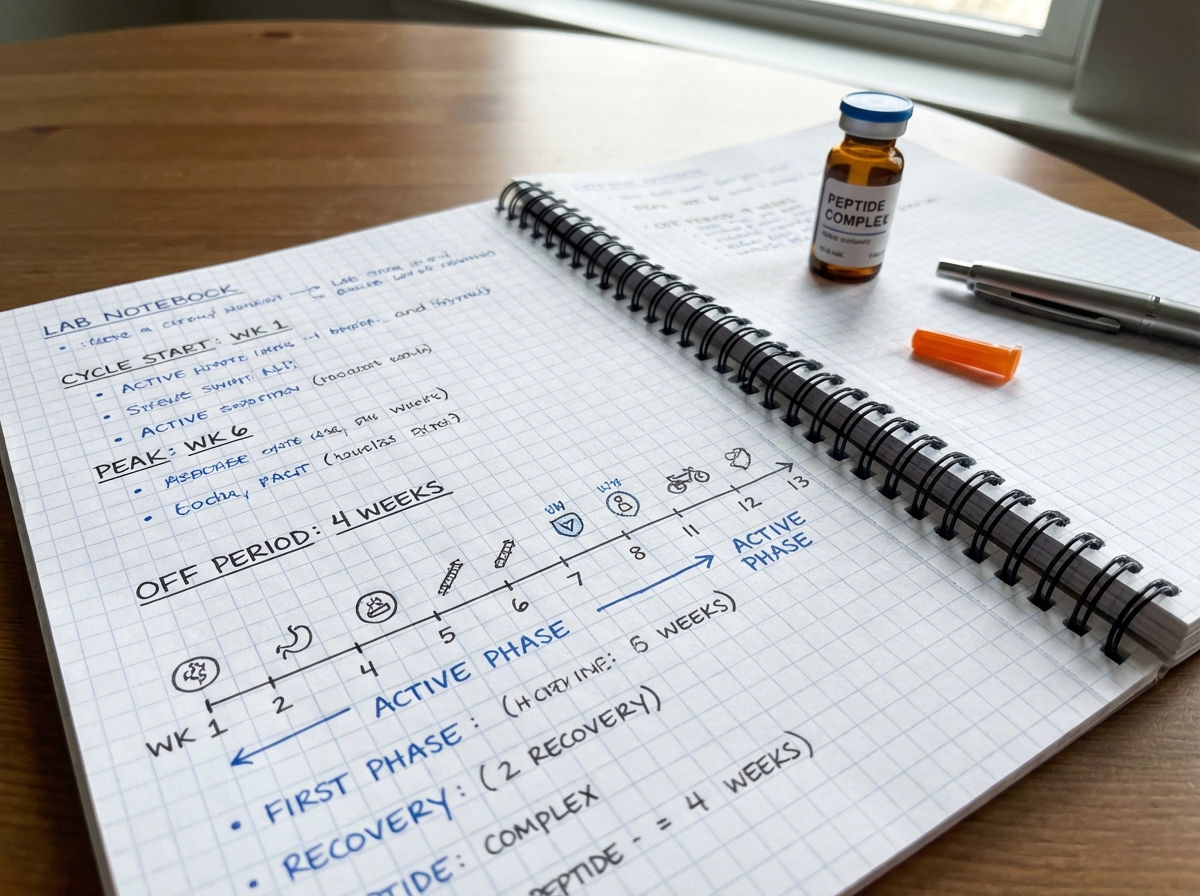
Peptide cycle length for weight-loss GLP-1 compounds
Semaglutide, tirzepatide, and newer combinations like cagrilintide plus semaglutide do not behave like classic short-cycle compounds. The strongest clinical data points in the opposite direction.
In STEP 4, semaglutide patients who stayed on treatment after the run-in phase maintained and extended their weight loss. In the STEP 1 extension, stopping treatment led to regain of about two-thirds of prior weight loss over the following year. That does not mean nobody should ever stop. It means the exit plan matters as much as the start date.
Tirzepatide showed the same long-horizon pattern in SURMOUNT-1, a 72-week trial in the New England Journal of Medicine. The benefit took time, and the people who got the biggest changes were not doing a six-week sprint.
So for GLP-1 class compounds, a practical peptide cycle length guide looks more like this:
- Initial assessment window: 8 to 12 weeks to judge tolerance and early response
- Meaningful body-composition window: 6 to 12 months
- Reason to stop: side effects, pregnancy planning, supply problems, or a structured maintenance pivot
- Main mistake: stopping the moment appetite drops without a maintenance plan in place
But there is an important nuance here. Approved obesity drugs have better evidence, yet they still are not casual tools. Nausea, vomiting, constipation, delayed gastric emptying, and poor adherence can wreck a plan if the escalation pace is sloppy.
If your main interest is this category, read Peptides for weight loss next. It gives better context on where these compounds sit relative to older fat-loss peptide claims.
Comparing common peptide cycles across one catalog?
Pinnacle carries weight-loss, recovery, and longevity compounds in one place, which makes side-by-side planning easier.
99% pure research peptides - use code Peptidepick15 for 15% off
Use code Peptidepick15 for 15% off your order
Peptide cycle length for recovery peptides
BPC-157 and TB-500 sit at the center of this category, but their evidence profiles are not equal to semaglutide or tirzepatide. Not close.
That is why the usual 4 to 8 week recovery cycle should be treated as an online convention, not a clinically settled standard. BPC-157 in particular is surrounded by strong claims and weak human data. Much of the early mechanistic literature comes out of a Zagreb research line, which is worth knowing because it shapes the narrative around the compound.
There is another issue. FDA language on BPC-157 is not gentle. The agency has warned about significant safety risks. That alone should kill the lazy habit of treating it like a harmless rehab add-on.
For most readers, the useful framework is:
- Use the shortest window that matches the research goal
- Do not assume longer means better tissue repair
- Stop when the target issue resolves or the effect is no longer clear
- Avoid stacking multiple low-evidence recovery compounds at once if you cannot tell what is doing what
If muscle, tendon, or post-training recovery is your main reason for looking up cycle lengths, this guide pairs well with Best peptides for muscle recovery.
And if your protocol requires mixing lyophilized vials, keep the free peptide reconstitution calculator handy. It saves time and cuts a lot of sloppy math errors.
Peptide cycle length for growth hormone secretagogues
CJC-1295, ipamorelin, sermorelin, and related compounds sit in the middle. They are not as well-supported as approved GLP-1 drugs, but they usually have more real-world protocol history than fringe longevity peptides.
Online, the most common cycle range for CJC-1295 and ipamorelin is 8 to 16 weeks. The logic is usually to allow enough time for body-composition or recovery changes, then take a break to reassess response and side effects.
That logic is reasonable. The problem is confidence. A lot of articles present those timelines as if they were carved into stone, when the better answer is that they are conventions shaped by community use, clinician preference, and the limits of the available literature.
So a cautious growth-secretagogue cycle usually looks like this:
- Short end: 8 weeks when you are testing tolerance or stacking lightly
- Middle range: 10 to 12 weeks for most body-composition or recovery discussions
- Longer end: 16 weeks only when monitoring is tighter and the rationale is clear
- Break: enough time to reassess sleep, appetite, water retention, glucose markers, and whether the effect actually justified the run
Some people will push these compounds much longer. I am not convinced that is smart for most readers, especially when the expected benefit is vague. If you cannot define the stop signal before you start, the cycle is already too loose.
For compound-specific prep, see how to reconstitute peptides and our guide to bacteriostatic water for peptides.

How to know when to stop or take a break
The best peptide cycle length guide is still useless if you never define the exit criteria. This is where a lot of protocols drift.
Good stop signals are concrete:
- The original goal was met
- Progress clearly plateaued
- Side effects are increasing faster than benefit
- Sleep, appetite, digestion, blood sugar, or edema are moving the wrong way
- You cannot tell whether the compound is still doing anything meaningful
Bad stop signals are emotional. Things like "I bought extra" or "most people online stay on longer" are how short experiments turn into open-ended use.
One more thing. If the protocol is research-grade and not prescription-grade, every added week carries extra uncertainty around purity, sterility, and consistency. Source quality matters there, which is why readers often start with our pages on best peptides for anti-aging and AOD-9604 before building longer plans.
Looking for third-party tested recovery and cognitive peptides?
Ascension is strong for classic research peptides and pre-built stacks without forcing you into a single niche.
60+ third-party tested research peptides and stacks
Oral alternatives and support options
Not everyone wants injectable research peptides, and that is a fair line to draw. If your goal is longevity support, focus, or general recovery support rather than a specific injectable protocol, Nootropics Depot is the cleaner fit. It is an oral supplement company, not a peptide vendor, so think of it as a complement or alternative rather than a direct substitute.
That distinction matters. Oral NMN, NADH, adaptogens, and cognition-focused supplements sit in a different evidence and risk bucket than injectable peptides. For some readers, that lower-friction route makes more sense than chasing an aggressive cycle.
Related articles
- Free Peptide Reconstitution Calculator
- How to Reconstitute Peptides
- Peptides for Weight Loss
- Best Peptides for Muscle Recovery
- Best Peptides for Anti-Aging
- Tesamorelin Peptide Guide
FAQ
How long should a peptide cycle last?
It depends on the compound category. Approved GLP-1 drugs are often used as long-term therapies, while recovery peptides are usually discussed in shorter 4 to 8 week windows.
Do you need to cycle BPC-157?
Most online protocols treat BPC-157 as a short-run compound, but human evidence is limited and FDA has flagged significant safety risks. That makes a conservative approach more sensible than indefinite use.
Can you stay on semaglutide long term?
Clinical trials suggest many patients benefit from longer-term treatment, and stopping often leads to weight regain. Long-term use still needs medical oversight and a clear maintenance plan.
How long should CJC-1295 and ipamorelin be used?
Online protocols often land in the 8 to 16 week range. The stronger point is not the exact week count, but whether the run has a clear goal and a defined stop signal.
Should you take a break between peptide cycles?
For many research peptides, yes. A break helps you assess whether the compound delivered a real benefit and whether side effects or biomarkers changed during the run.
Can multiple peptides be stacked on the same cycle?
They can, but stacking raises complexity fast. It becomes harder to spot which compound is helping, which one is causing side effects, and whether the combined plan still fits the evidence.