
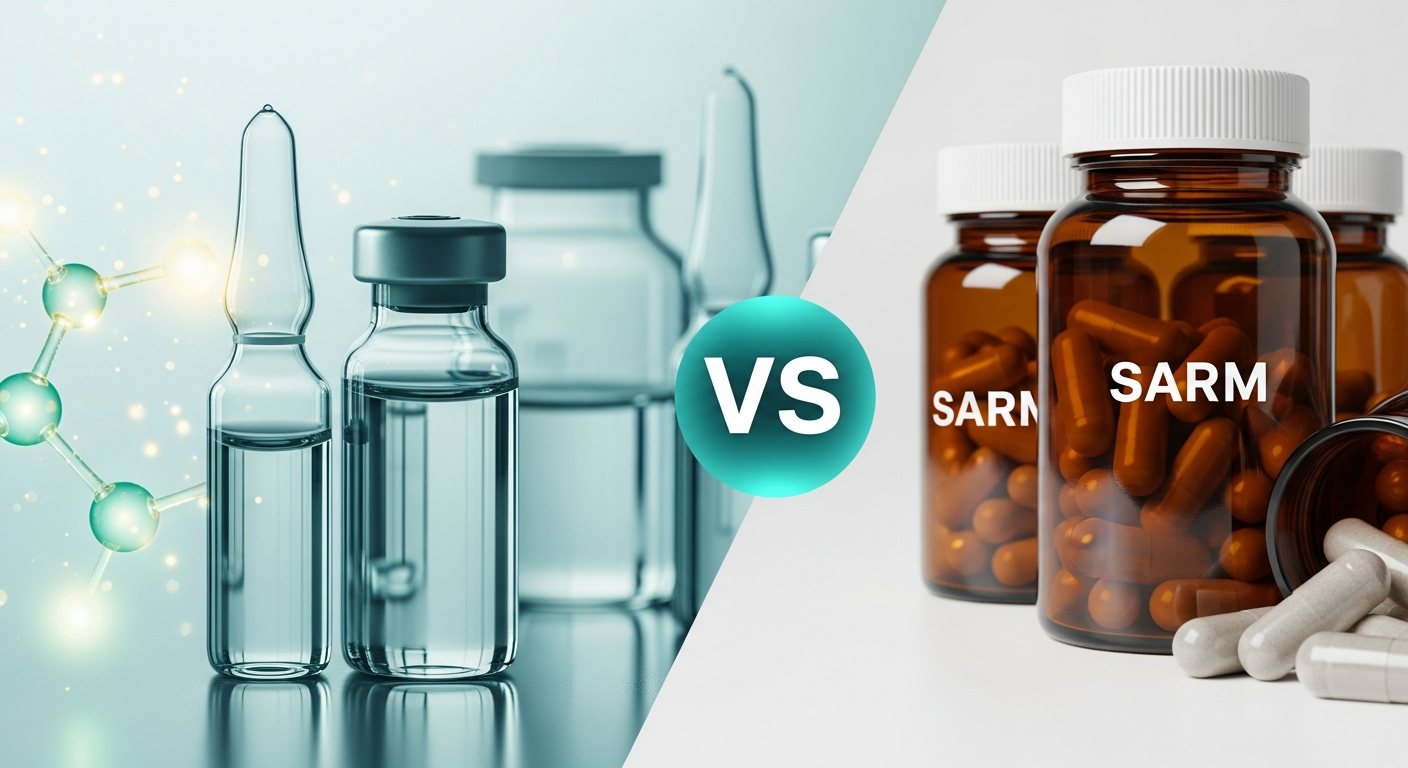
Peptides vs SARMs: Key Differences Explained
Peptides and SARMs show up in the same forums, the same supplier catalogs, and the same fitness conversations. That proximity creates confusion. They are fundamentally different compound classes with different mechanisms, different risk profiles, and different regulatory histories. This guide breaks down exactly how they compare - backed by published research rather than gym anecdotes.

Looking for a trusted source? Pinnacle Peptide Labs carries 99% pure, third-party tested peptides. Use code Peptidepick15 for 15% off your order.
Want a non-injectable option? Nootropics Depot carries third-party tested oral supplements for cognitive function, longevity, and recovery - no reconstitution needed.
What Are Peptides? What Are SARMs?
Peptides: Your Body's Signaling Molecules
Peptides are short chains of amino acids - typically between 2 and 50 residues linked by peptide bonds. Your body produces hundreds of them naturally. They function as signaling molecules, telling cells to perform specific tasks: release growth hormone, initiate tissue repair, reduce inflammation, or regulate appetite.
Research peptides replicate or enhance these natural signals. BPC-157, for example, is a synthetic version of a peptide found in human gastric juice. TB-500 mirrors a segment of thymosin beta-4, a protein involved in cell migration and wound healing. Growth hormone secretagogues like CJC-1295 and Ipamorelin stimulate the pituitary gland to produce more of its own growth hormone.
The common thread: peptides work with existing biological systems rather than overriding them.
SARMs: Synthetic Androgen Receptor Binders
SARMs - Selective Androgen Receptor Modulators - are synthetic compounds designed to bind androgen receptors in muscle and bone tissue. They were originally developed in the late 1990s as potential treatments for muscle wasting, osteoporosis, and hypogonadism. The goal was to deliver testosterone-like anabolic effects without the broad androgenic side effects of traditional steroids.
Common SARMs include Ostarine (MK-2866), Ligandrol (LGD-4033), and RAD-140. None have received FDA approval for any indication. They remain investigational compounds.
How They Work: Mechanism of Action
Peptide Signaling: Broad and Indirect
Peptides operate through diverse pathways. Growth hormone secretagogues bind to ghrelin receptors (GHS-R1a) or growth hormone-releasing hormone receptors on pituitary somatotrophs, triggering pulsatile GH release. A 2014 study in the Journal of Clinical Endocrinology found that CJC-1295 increased mean GH levels by 2-10 fold over baseline for 6+ days after a single injection.
Repair peptides like BPC-157 work through entirely different mechanisms. Research published in the Journal of Physiology-Paris (2018) demonstrated that BPC-157 upregulates growth factor expression (VEGF, EGF) and promotes angiogenesis - the formation of new blood vessels at injury sites. TB-500 promotes actin polymerization, which supports cellular migration to damaged tissue.
The result is a systems-level response. No single receptor gets hammered. Multiple pathways coordinate.
SARM Binding: Targeted but Hormonal
SARMs bind selectively to androgen receptors in skeletal muscle and bone. Unlike anabolic steroids, they were designed to avoid significant binding in prostate, skin, and liver tissue. The selectivity is real but imperfect.
A 2013 study in Endocrine Reviews showed that Ostarine at 3mg/day increased lean mass by 1.4 kg over 12 weeks in healthy elderly participants. But the same study noted dose-dependent suppression of luteinizing hormone (LH) and follicle-stimulating hormone (FSH) - the hormonal signals that tell the body to produce its own testosterone. At higher doses, suppression becomes significant enough to require post-cycle therapy.
This is the core tradeoff. SARMs deliver measurable anabolic effects. They also suppress the hypothalamic-pituitary-gonadal (HPG) axis, because the body detects exogenous androgen receptor activation and down-regulates its own production.

Head-to-Head Comparison
| Category | Peptides | SARMs |
|---|---|---|
| Chemical Class | Amino acid chains (2-50 residues) | Synthetic non-steroidal compounds |
| Primary Mechanism | Stimulate natural signaling (GH release, repair cascades) | Bind androgen receptors directly |
| Hormonal Suppression | Minimal to none | Dose-dependent testosterone suppression |
| PCT Required | No | Often yes (especially LGD-4033, RAD-140) |
| Liver Toxicity | Not reported in research literature | Raised liver enzymes reported (ALT/AST) |
| FDA Status | Sold as research chemicals; some in clinical trials | Not approved; FDA warning letters issued |
| WADA Status | GH secretagogues banned in competition | All SARMs banned in and out of competition |
| Administration | Subcutaneous injection (most), oral (BPC-157) | Oral (liquid or capsule) |
| Primary Use Cases | Recovery, anti-aging, sleep, fat loss, healing | Muscle growth, body recomposition, strength |
| Typical Cycle Length | 4-12 weeks (some used ongoing) | 8-12 weeks with mandatory off-cycle |
Legal Status and Regulation
The legal picture differs substantially between these two classes.
Peptides are broadly available as research chemicals in the United States. They cannot legally be sold for human consumption, but purchasing them for research purposes remains lawful. Several peptides are in active FDA clinical trials - tesamorelin (a GHRH analog) already holds FDA approval for HIV-associated lipodystrophy. The regulatory direction for peptides has been toward increased clinical adoption.
SARMs face a harsher regulatory environment. The FDA has issued multiple warning letters to companies selling SARMs, and in 2019 the SARMs Control Act was introduced (though not yet passed as of early 2026) to classify them as Schedule III controlled substances alongside anabolic steroids. The FDA's 2017 public advisory explicitly warned consumers against SARM use, citing liver injury, heart attack risk, and stroke.
Both compound classes appear on WADA's prohibited list. GH secretagogue peptides are banned under section S2 (Peptide Hormones and Modulators). SARMs have their own dedicated category (S1.2) and are banned both in and out of competition.
Safety Profiles and Side Effects
Peptide Side Effects
Published research on peptides like BPC-157, TB-500, and GH secretagogues shows a relatively mild side effect profile. Common reports include:
- Injection site reactions (redness, mild swelling) - reported in approximately 10-15% of clinical trial participants
- Water retention with GH secretagogues - typically transient, resolving within 2-3 weeks
- Increased hunger with ghrelin-mimetic compounds (Ipamorelin, and the non-peptide secretagogue MK-677)
- Mild headaches and flushing - reported in under 5% of participants in CJC-1295 trials
- Tingling or numbness in extremities (associated with higher GH)
No published studies on BPC-157 or TB-500 have reported serious adverse events. For a deeper look, see our full peptide side effects guide.
SARM Side Effects
SARMs carry a more significant risk profile. Published data includes:
- Testosterone suppression: A 2020 JAMA study found that LGD-4033 at 1.0mg/day suppressed total testosterone by 55% and free testosterone by 41% over 21 days
- Liver toxicity: Multiple case reports document drug-induced liver injury (DILI) with SARMs. A 2020 review in Liver International identified 44 cases of SARM-associated hepatotoxicity
- Lipid changes: Ostarine at 3mg/day reduced HDL cholesterol by 27% over 12 weeks (Dalton et al., 2011)
- Hair thinning and acne: Androgenic side effects reported despite "selective" receptor binding
- Unknown long-term effects: No SARM has completed Phase III clinical trials, so long-term safety data simply does not exist
The difference in side effect severity is the single biggest factor driving researchers from SARMs toward peptides.
One additional safety consideration: peptide quality varies wildly between suppliers. Underdosed products, contaminated batches, and missing certificates of analysis are common in the research chemical market. Always verify third-party HPLC testing before using any peptide in a research protocol. Our quality verification guide covers what to look for.

Use Case Comparison
Recovery and Injury Healing
Peptides dominate this category. BPC-157 has demonstrated tendon, ligament, muscle, and gut healing across dozens of animal studies. TB-500 supports similar tissue repair through actin regulation. SARMs offer no direct recovery mechanism - any healing benefit comes indirectly through increased lean mass supporting joint stability.
For researchers prioritizing recovery, peptides are the clear choice.
Muscle Growth
SARMs produce more direct and rapid increases in lean mass. Ostarine studies show 1-3 lbs of lean mass gain over 12 weeks even without resistance training. LGD-4033 and RAD-140 produce more pronounced effects.
Peptides approach muscle growth differently. GH secretagogues like CJC-1295/Ipamorelin increase growth hormone and IGF-1, which supports muscle protein synthesis, improves recovery between training sessions, and enhances sleep quality - all of which contribute to muscle growth over longer timescales. The gains are less dramatic per cycle but come without hormonal suppression. Check our guide on the best peptides for muscle recovery for specific protocols.
Fat Loss
Both classes show fat loss potential through different mechanisms. GH secretagogues increase lipolysis (fat breakdown) through elevated growth hormone. Early research suggested that CJC-1295 may support fat mass reduction through sustained GH increase, though specific percentage claims vary across studies. SARMs promote favorable body recomposition through increased metabolic rate from added lean mass. Peptides offer a slight edge here because they target fat mobilization directly without suppressing natural hormone production.
Anti-Aging and Longevity
This is almost exclusively peptide territory. GH secretagogues improve skin elasticity, sleep quality, bone density, and cognitive function through restored growth hormone pulsatility - all documented in clinical research. Epithalon, a telomerase-activating peptide, has shown telomere length preservation primarily in animal models, though independent replication remains limited. SARMs were never designed for anti-aging applications and offer little in this domain.
Which Should You Choose? A Decision Framework
Choose peptides if your research goals include:
- Injury recovery and tissue healing
- Improved sleep quality and recovery
- Anti-aging and longevity biomarkers
- Fat loss without hormonal disruption
- Gradual, sustainable body composition improvement
- Stacking with an existing training program long-term
SARMs may be considered for research involving:
- Rapid lean mass accrual in short timeframes
- Muscle wasting conditions (the original clinical intent)
- Body recomposition when hormonal suppression risk is accepted
For most researchers, peptides offer a better risk-to-benefit ratio. The effects build more gradually, but they compound over time without the cyclical hormonal disruption that SARMs require.
Why Researchers Are Switching from SARMs to Peptides
Online research communities have shown a measurable shift. Three factors drive it.
1. No post-cycle therapy. SARMs require PCT protocols (often involving additional compounds like Nolvadex or Clomid) to restore natural testosterone production. Peptides do not suppress the HPG axis, eliminating this requirement entirely.
2. Broader benefits. SARMs do one thing: activate androgen receptors. Peptides address multiple systems simultaneously. A researcher using BPC-157 + CJC-1295/Ipamorelin gets tissue repair, improved sleep, increased GH, and enhanced recovery - a multi-system benefit stack that SARMs cannot match.
3. Regulatory trajectory. With the SARMs Control Act looming and FDA enforcement increasing, many researchers see peptides as having a more stable legal future. Several peptides are advancing through legitimate clinical trials, while SARMs face increasing restriction.
Trusted peptide suppliers like Swiss Chems (visit site), Core Peptides, and Paradigm Peptides provide third-party tested research compounds with certificates of analysis - a level of quality assurance that has become standard in the peptide space.