
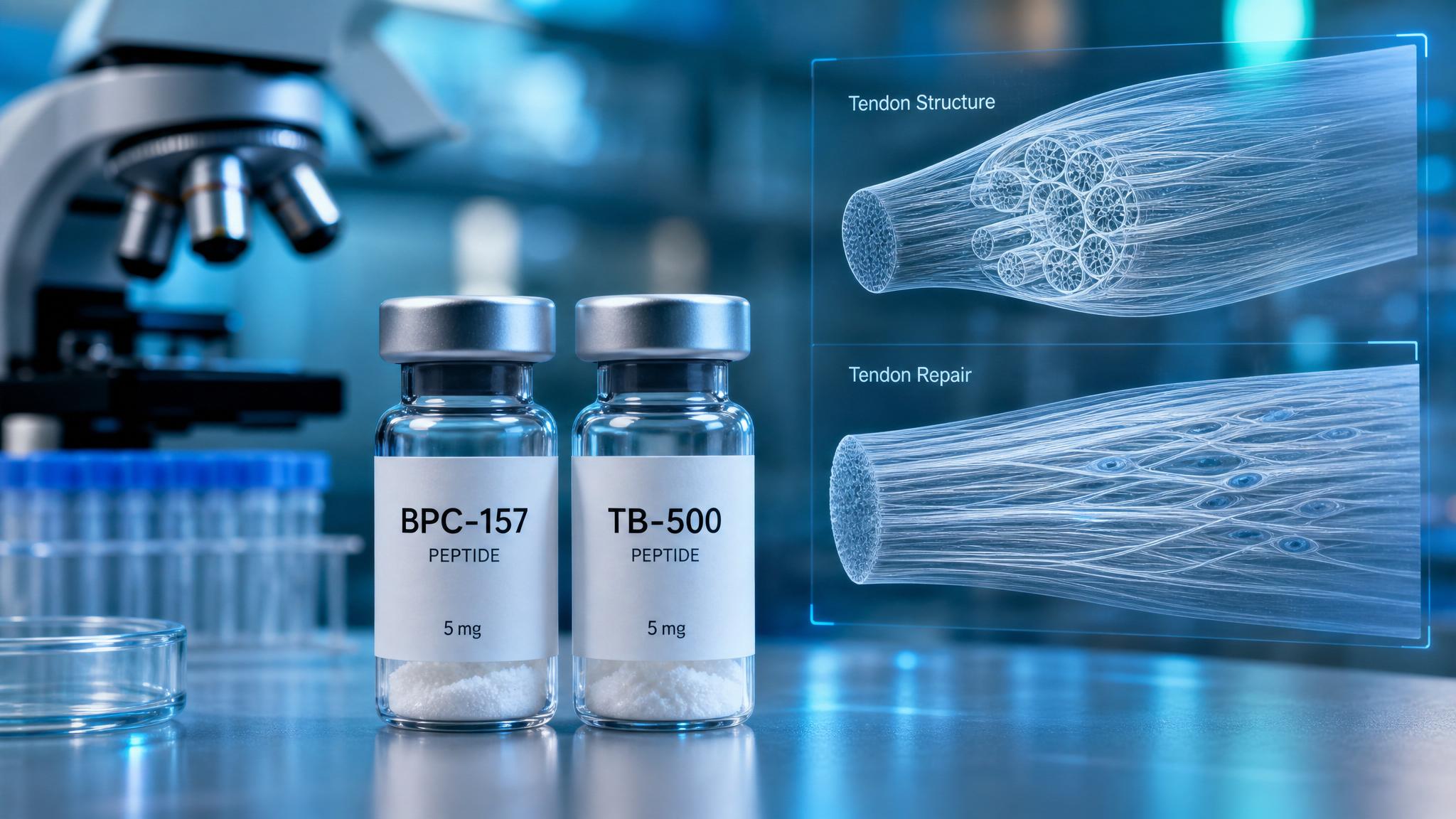
Stacking BPC-157 and TB-500: Research Guide, Safety, and Protocol Logic
stacking BPC-157 and TB-500 gets searched because the logic is easy to understand: one compound is usually discussed for local tissue signaling, the other for broader repair pathways. That does not make the stack proven, standardized, or risk-free.
The honest answer is more useful. Animal and cell studies make the combination interesting. Human evidence is thin, dosing claims online are mostly clinic convention or vendor copy, and BPC-157 carries a specific FDA safety-risk flag in the compounding context.
TLDR
- Stacking BPC-157 and TB-500 is best framed as a research concept, not a validated medical protocol.
- BPC-157 has preclinical tendon data, including a 2011 rat Achilles tendon fibroblast study showing improved cell survival and migration through FAK-paxillin signaling.
- TB-500 is commonly discussed as a thymosin beta-4 fragment, while most published evidence is on thymosin beta-4 itself.
- For recovery-stack sourcing, Pinnacle Peptide Labs is the strongest fit because it carries a Wolverine Blend and separate BPC-157 and TB-500 products.
- Use PeptidePick's free peptide reconstitution calculator and reconstitution guide for research math, not medical dosing.
What stacking BPC-157 and TB-500 means
In peptide forums and clinic content, a stack means using two compounds in the same research window because their mechanisms are thought to cover different parts of tissue repair. For this keyword, the usual pairing is BPC-157 plus TB-500.
BPC-157 is a synthetic 15-amino-acid peptide related to a body protection compound studied by the Zagreb research group led by Predrag Sikiric and colleagues. That origin matters because a lot of BPC-157 claims trace back to a narrow group of preclinical papers rather than broad independent human trials.
TB-500 is commonly marketed as a synthetic fragment associated with thymosin beta-4 biology. Most stronger literature discusses thymosin beta-4 itself, a naturally occurring 43-amino-acid peptide involved in actin binding, cell migration, angiogenesis signals, inflammation control, and wound repair models.
The stack idea is simple but not settled:
- BPC-157: often framed around local tendon, ligament, gut, and soft-tissue injury models.
- TB-500 or thymosin beta-4 related research: often framed around systemic tissue repair signaling, cell migration, and inflammation modulation.
- The combined theory: local repair support plus broader remodeling support.
That theory is plausible enough to study. But it is not the same thing as proof that a human recovery protocol works.
Researching a recovery stack?
Pinnacle Peptide Labs carries BPC-157, TB-500, and recovery-focused blends for lab research.
Use code Peptidepick15 for 15% off your order
99% pure research peptides - use code Peptidepick15 for 15% off
Stacking BPC-157 and TB-500: what the research actually shows
The strongest way to read the evidence is compound by compound. There is not a clean human trial proving that stacking BPC-157 and TB-500 heals injuries faster than either compound alone.
BPC-157 tendon and soft-tissue evidence
A 2011 study in Journal of Applied Physiology looked at BPC-157 in rat Achilles tendon fibroblast models. The authors reported that BPC-157 promoted tendon explant outgrowth, improved cell survival under hydrogen peroxide stress, increased tendon fibroblast migration, and activated the FAK-paxillin pathway.
That study matters because tendon healing depends on fibroblast migration and extracellular matrix remodeling. It also has a hard limit: it was not a randomized human injury trial.
Other BPC-157 papers discuss gastric protection, angiogenic effects, ligament models, muscle injury models, and gut repair mechanisms. The pattern is interesting. It is also heavily preclinical.
Thymosin beta-4 and TB-500 evidence
Thymosin beta-4 has a broader literature base than TB-500 as a branded research peptide. A 2012 review by Goldstein, Hannappel, Sosne, and Kleinman described thymosin beta-4 as a regenerative peptide with roles in cell migration, angiogenesis-related signaling, inflammation control, and repair of injured tissue.
Eye research is one of the cleaner areas. A 2002 Experimental Eye Research paper found that thymosin beta-4 promoted corneal wound healing and reduced inflammation after alkali injury in an animal model. Later reviews discussed clinical development for ocular repair, including dry eye and neurotrophic keratopathy research.
But TB-500 is not identical to the full thymosin beta-4 literature. That is the nuance most vendor pages skip. TB-500 may be discussed through thymosin beta-4 mechanisms, yet readers should not treat every thymosin beta-4 study as direct proof for every TB-500 product.
What stacking adds in theory
The stack argument rests on complementary timing and mechanism. BPC-157 may be more relevant to localized tendon, ligament, and gut models. Thymosin beta-4 related pathways may be more relevant to cell migration and repair signaling across tissue types.
Online competitors usually turn that into a simple protocol claim: BPC-157 daily, TB-500 weekly, often for 4 to 8 weeks. That may reflect common clinic patterns. It is not a universal research standard.
For deeper background, read PeptidePick's Wolverine Stack guide, joint repair stack guide, and peptides for tendon repair article. Those pieces cover related recovery compounds without turning weak evidence into certainty.
| Question | BPC-157 | TB-500 / thymosin beta-4 related research |
|---|---|---|
| Main research angle | Localized tendon, ligament, gut, and soft-tissue models | Cell migration, inflammation modulation, angiogenesis signals, repair models |
| Evidence type | Mostly animal and cell research | Animal, cell, review, and ocular clinical-development literature for thymosin beta-4 |
| Best use of the evidence | Mechanistic research framing | Mechanistic research framing, especially for repair signaling |
| Big caveat | FDA has flagged BPC-157 as raising significant safety risks in the compounding bulk-substance context | TB-500 product claims often borrow from full thymosin beta-4 evidence |
Stacking BPC-157 and TB-500 protocol logic
A good research protocol starts with the question, not the dose. The model might focus on tendon repair, ligament remodeling, muscle injury, gut barrier injury, or general recovery signaling.
That distinction matters because BPC-157 is often presented as the local signal in the stack. TB-500 is often presented as the broader repair signal. If the research model does not need both angles, stacking may add cost and variables without adding clarity.
Research teams usually think through these design points:
- Single compound first: using BPC-157 alone or TB-500 alone makes outcomes easier to interpret.
- Combination arm: a stack only becomes useful if the study can compare it against each compound separately.
- Timing: tissue injury models often separate acute inflammation, migration, proliferation, and remodeling phases.
- Route and handling: peptide stability, sterility, and storage can change the meaning of results.
This is why PeptidePick does not publish a universal human dosing protocol for stacking BPC-157 and TB-500. The internet already has enough confident charts with thin evidence behind them.
For research math, use the PeptidePick reconstitution calculator. For sterile handling basics, read how to reconstitute peptides and bacteriostatic water for peptides.
Safety and legal issues before stacking BPC-157 and TB-500
The safety section is where the hype usually breaks down. BPC-157 is not FDA-approved, and the FDA has listed BPC-157 among bulk drug substances that may present significant safety risks in the compounding context.
That wording matters: significant safety risks. Do not soften it into "insufficient safety data" if you are trying to be accurate.
Potential research concerns include:
- unknown human risk profile for long-term or repeated exposure
- immune reaction risk from peptide impurities or contaminants
- poor characterization of active pharmaceutical ingredient quality in gray-market supply
- sterility problems with injectable research materials
- hard-to-interpret effects when multiple compounds are combined
TB-500 has its own problem: product identity. Many articles slide between TB-500 and thymosin beta-4 as if they are interchangeable. They are related in discussion, but not every study on full thymosin beta-4 proves a commercial TB-500 claim.
There is also the sports angle. Peptides that affect recovery or growth pathways can create anti-doping problems. Competitive athletes should treat this category as high risk and check current WADA and sport-specific rules before touching any research peptide.
For broader legality context, read Are peptides legal to buy? and PeptidePick's best peptide companies guide. The second article focuses on sourcing quality, testing, and vendor transparency rather than medical claims.
Need more delivery-form options?
Limitless Biotech has a large catalog with injectable, spray, and capsule formats for qualified research accounts.
118+ research peptides in injectable, spray, and capsule forms - create a free account to access the full catalog. Use code PeptidePick for a discount at checkout.
Research sourcing notes for a BPC-157 and TB-500 stack
If a lab is comparing BPC-157, TB-500, and a combined arm, sourcing consistency matters. Different suppliers, purity levels, fill weights, and storage conditions can make the results noisy before the study even starts.
Look for basics that can be checked:
- third-party testing with lot-specific COAs
- clear labeling for research use only
- published storage guidance
- transparent product naming, especially for TB-500 versus thymosin beta-4 claims
- real customer support, not just a checkout page
For recovery-focused research, Pinnacle is the cleanest match because it carries BPC-157, TB-500, and ready-made recovery stacks. Ascension is also a strong recovery vendor, especially for BPC-157, TB-500, and KPV-related research. Limitless is the best fit when delivery-form variety matters.
One more nuance: if the goal is non-injectable recovery support, peptide research may not be the first place to start. Oral supplement alternatives do not replace BPC-157 or TB-500, but third-party tested supplements can be easier to evaluate for general wellness routines. Nootropics Depot is a supplement vendor, not an injectable peptide source.
Bottom line on stacking BPC-157 and TB-500
Stacking BPC-157 and TB-500 makes mechanistic sense as a research question. BPC-157 has preclinical tendon and soft-tissue data. Thymosin beta-4 has repair and wound-healing literature that explains why TB-500 became popular in recovery stacks.
But the stack is not a proven human healing protocol. The best article on this topic should say that plainly.
If you are comparing vendors for recovery research, start with quality controls, not the loudest protocol chart. Read the COA, check the peptide identity, keep the study design simple, and avoid treating preclinical findings as medical instructions.
Compare recovery peptides from a broad catalog
Ascension Peptides carries BPC-157, TB-500, KPV, SS-31, and recovery-focused research stacks.
60+ third-party tested research peptides and stacks
FAQ: stacking BPC-157 and TB-500
Can BPC-157 and TB-500 be stacked together?
They are often discussed together in research and clinic content because the mechanisms may be complementary. That does not mean the stack is proven in human trials or approved for medical use.
What is the difference between BPC-157 and TB-500?
BPC-157 is usually discussed around localized tendon, ligament, gut, and soft-tissue models. TB-500 is usually discussed through thymosin beta-4 related repair pathways, including cell migration and inflammation modulation.
Is there a standard dose for stacking BPC-157 and TB-500?
No universal standard exists. Online protocols often repeat similar dose ranges, but those are not the same as FDA-approved prescribing guidelines or validated trial protocols.
Is BPC-157 FDA approved?
No. BPC-157 is not FDA approved for injury recovery or any medical use. The FDA has also flagged BPC-157 as a bulk drug substance that may present significant safety risks in the compounding context.
Is TB-500 the same as thymosin beta-4?
Not exactly. TB-500 is commonly marketed in relation to thymosin beta-4 biology, but many stronger studies involve full thymosin beta-4 rather than a commercial TB-500 product.
Which vendor is best for recovery-stack research?
Pinnacle Peptide Labs is the strongest fit for recovery-stack research because it carries BPC-157, TB-500, and recovery-focused blends. Ascension and Limitless are also useful depending on catalog needs.