
PeptidePick preferred picks
Use the highest-value vendor routes first.
Pinnacle is first for the 15% discount code. Ascension is the broad-catalog default when you want the cleaner research-only route.
Research-only affiliate links. Verify COAs, labels, and shipping terms before checkout.
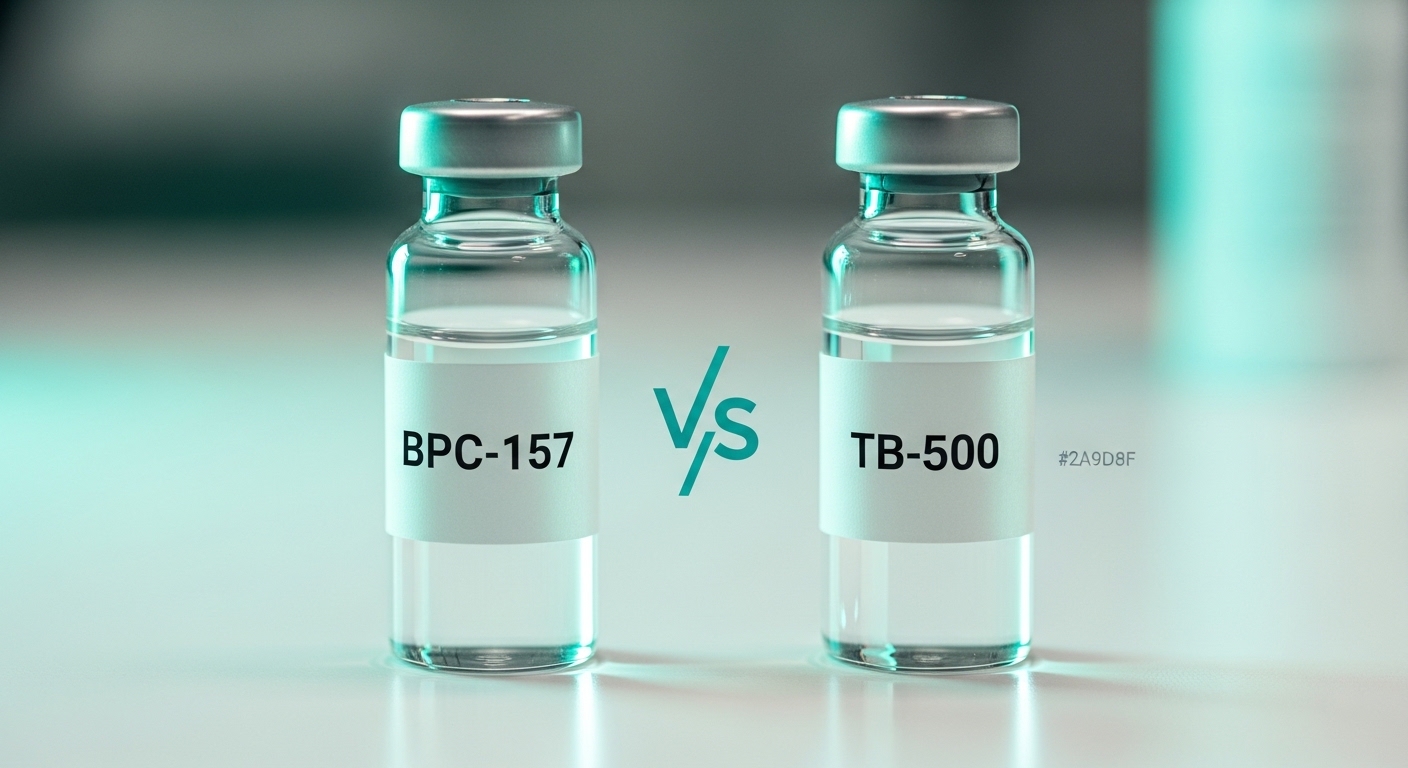
BPC-157 vs TB-500: Key Differences, Benefits, and Which to Choose
Bottom Line
BPC-157 is a locally-acting gastric peptide best suited for gut healing and tendon repair research, costing $35-65/month. TB-500 is a systemic peptide that promotes body-wide recovery through cell migration, primarily studied for cardiac and muscle repair, at $70-220/month. BPC-157 is cheaper and can be taken orally; TB-500 has stronger clinical trial evidence. Many researchers use both together (the "Wolverine Stack").
BPC-157 and TB-500 are the two most popular peptides in regenerative research. Both show tissue-healing properties in animal studies. Both attract attention from researchers studying injury recovery. But they work through fundamentally different mechanisms, target different tissues, and carry different cost profiles. This guide breaks down the real differences based on published research - so you can decide which peptide fits your research goals.
Useful PeptidePick Resources for BPC-157 vs TB-500
Before comparing vendors or research notes, these core PeptidePick resources help keep the basics straight:
Related TB-500 and BPC-157 guides
Use these companion pages when the comparison turns into a safety, stacking, or recovery-specific question.
- TB-500 side effects - safety and risk notes
- BPC-157 for back pain - musculoskeletal research context
- stacking BPC-157 and TB-500 - combined research logic
Approved PeptidePick Vendor Options
PeptidePick only uses approved affiliate links that are listed in our internal registry. For BPC-157 vs TB-500, compare current research-only vendors by testing transparency, catalog fit, shipping policy, and support responsiveness before making any decision.
Compare Ascension Peptides
60+ third-party tested research peptides and peptide stacks.
Compare Limitless Biotech
118+ research products in injectable, spray, and capsule formats. Create a free account to unlock the catalog.
Unlock Limitless VIP Catalog →
Use code PeptidePick as a secondary checkout incentive after creating the free VIP account.
Compare Pinnacle Peptide Labs
99% pure research peptides. Use code Peptidepick15 for 15% off.
Use code Peptidepick15 for 15% off your order.
BPC-157 vs TB-500: Research Context
BPC-157 vs TB-500 needs careful framing because peptide content often mixes early-stage research, anecdotal community claims, and vendor marketing. PeptidePick treats this page as a research reference, not a protocol. The goal is to help readers understand what questions to ask before comparing compounds, suppliers, or dosing discussions.
Most peptide topics sit on uneven evidence. Some compounds have mechanistic or animal data, some have small human studies, and some have mostly commercial claims. That difference matters. A compound with interesting pathway data is not the same thing as a proven therapy, and a clean-looking vendor page is not the same thing as independent quality control.
What To Check Before Acting On BPC-157 vs TB-500 Claims
Start with the claim itself. Is the page talking about a published study, a proposed mechanism, a user report, or a seller's marketing copy? Those are different evidence levels. Stronger research usually states the model, dose range, route, endpoints, and limitations. Weak content usually jumps straight from a mechanism to a promise.
For any peptide or research compound, check whether the claim depends on a specific formulation or route. A nasal spray, capsule, topical serum, and injectable research vial can behave differently. That is one reason PeptidePick avoids one-size-fits-all recommendations and links readers back to basic measurement and reconstitution references.
- Look for third-party testing and recent batch documentation.
- Check whether the article separates animal, cell, and human evidence.
- Be skeptical of exact outcome claims without a source.
- Confirm storage and handling instructions before comparing vendors.
- Use conservative language around safety, legality, and personal use.
Quality Control And Vendor Fit
Vendor quality is the practical bottleneck. Even a well-researched compound can be a bad decision if the supplier has weak documentation, unclear shipping conditions, or no meaningful customer support. PeptidePick favors vendors with transparent testing, clear catalog organization, and stable affiliate links that can be tracked and audited.
That last point is not just administrative. Broken or unapproved vendor links create a bad reader experience and make it harder to know which recommendations are current. This page now uses only approved PeptidePick affiliate destinations or internal comparison links.
Measurement, Reconstitution, And Storage Basics
Many peptide mistakes start with measurement. Milligrams, micrograms, vial concentration, and syringe units are easy to mix up if the math is rushed. That is why PeptidePick routes readers to its calculator and reconstitution guide instead of embedding casual dosing shortcuts into every article.
If a topic involves lyophilized peptide vials, storage and handling also matter. Light exposure, temperature swings, repeated punctures, and the wrong diluent can all change the reliability of a research setup. These details are boring, but they are often where quality problems start.
How This Page Should Be Used
Use this guide as a starting point for research, not as personal medical advice. The safer pattern is simple: understand the evidence level, compare quality controls, read the legal and safety context, and keep vendor claims separate from published research. If a page skips those steps, it is probably trying to sell too quickly.
PeptidePick will keep updating older pages as better research and cleaner vendor data become available. When a topic has limited evidence, the page should say that plainly instead of filling space with certainty it has not earned.
Evidence Levels To Watch
The strongest peptide pages separate evidence into buckets. A cell study can help explain a pathway, but it does not tell you how a compound performs in people. Animal research can be useful, but it still leaves major translation questions. Human research is more useful when it has clear endpoints, a reasonable sample size, and transparent safety reporting.
That distinction is especially important with BPC-157 vs TB-500. Search results often mix research summaries with sales pages, forum comments, and copied vendor claims. If a claim sounds exact but the source is vague, slow down. Ask where the number came from, what model it came from, and whether the outcome is directly relevant to the question you are trying to answer.
PeptidePick does not treat popularity as proof. A compound can be popular because it is promising, but it can also be popular because affiliates, social posts, or bodybuilding forums repeat the same line. The page should earn trust by showing uncertainty where uncertainty exists.
Safety And Legal Context
Many peptides discussed online are sold for research use, not as approved consumer treatments. That matters for labeling, quality control, medical supervision, and risk. Even when a compound has legitimate research interest, the commercial version a reader sees online may not have gone through the same controls as a regulated medication.
Readers should also separate legal status from safety. Something can be easy to buy and still carry meaningful risk. Something can be under active research and still not be appropriate for unsupervised personal use. PeptidePick uses cautious wording because those distinctions are easy to blur.
For topics that involve GLP-1s, injury recovery, injection supplies, or cognitive compounds, the safety context gets even more important. Side effects, contraindications, sterility, storage, and dosing math are not side notes. They are part of the main decision.
Vendor Documentation Checklist
Before trusting a vendor page tied to BPC-157 vs TB-500, look for documentation that can be checked outside the sales copy. A useful certificate of analysis should identify the product, batch, test method, test date, and lab. A weak certificate may be old, generic, cropped, or missing batch-level detail.
Shipping and storage details are also part of quality. Peptides can be sensitive to heat, light, and handling conditions. A vendor that says nothing about packaging, replacement policy, or support may still ship a product, but the buyer has less protection if something goes wrong.
- Batch-specific COA or third-party testing page.
- Clear product labeling and concentration details.
- Shipping policy that explains delays, heat exposure, and replacements.
- Support channel that responds before a purchase, not only after.
- Return or reship policy written in plain language.
How PeptidePick Handles Affiliate Links
PeptidePick only uses affiliate links that are stored in the internal affiliate registry. That is why old or pending links are removed during audits. If a vendor is not approved, it can still be discussed editorially, but it should not be presented as a live affiliate CTA.
This protects tracking and reader trust. It also keeps the site from sending traffic to old programs that may no longer credit properly. If Tim adds a new vendor later, the right fix is to update the registry first, then update the affected pages from that source of truth.
When To Compare Alternatives
For some readers, BPC-157 vs TB-500 may not be the best starting point. A broader comparison page can make more sense when the goal is to understand vendor quality, delivery formats, or adjacent compounds. That is why PeptidePick routes readers to the vendor comparison page and related guides instead of forcing every page into a single recommendation.
Good research pages help readers narrow the question. Is the goal skin support, recovery research, metabolic comparison, measurement accuracy, or cognitive research context? Once the question is clear, vendor selection and source checking become easier.
Editorial Notes For Older PeptidePick Pages
This page was updated as part of a sitewide PeptidePick quality pass. Older articles sometimes had thin copy, missing images, outdated vendor links, or weak internal linking. The current version adds research framing, approved affiliate destinations, and links to the core PeptidePick tools so the page is useful even before a full topic-specific rewrite.
The update does not mean every claim in the wider internet conversation about BPC-157 vs TB-500 is settled. It means this page now has a safer structure: a research-only disclaimer, better reader resources, approved vendor links, and clearer language around uncertainty. When a future evidence review finds stronger data, the topic can be rewritten with more specific study citations and a tighter recommendation.
Readers should still check publication dates, vendor testing dates, and current product availability. Peptide vendors change catalogs, affiliate terms, and testing pages over time. A link that was useful last quarter can become stale. PeptidePick's audit process is designed to catch those issues before they turn into broken tracking or bad recommendations.
If you are comparing BPC-157 vs TB-500 against adjacent compounds, use the internal links on this page instead of jumping straight to a checkout page. The comparison step matters. It reduces the chance of mistaking a trendy compound for the right research fit, and it keeps the decision grounded in evidence, handling requirements, and supplier quality.
BPC-157 vs TB-500 FAQ
Is BPC-157 vs TB-500 medical advice?
No. PeptidePick content is educational and research-focused. It is not a diagnosis, treatment plan, dosing protocol, or substitute for a licensed clinician.
Are the vendors on this page approved by PeptidePick?
Affiliate CTAs use only the approved links in the PeptidePick affiliate registry. Older links to pending or non-approved vendors are replaced with internal comparison links or approved alternatives.
Why does PeptidePick link to reconstitution resources from many articles?
Measurement and handling errors are common in peptide research discussions. The calculator and reconstitution guide help readers understand the math and safety context before comparing suppliers.
Does a third-party test guarantee safety?
No. A test can support purity or identity for a batch, but it does not prove a compound is safe or appropriate for personal use.
How often should this type of page be checked?
Vendor availability, testing policies, and research context can change. PeptidePick treats older pages as candidates for periodic review, especially when they mention vendors, pricing, or protocols.