
FDA research disclaimer: Peptides discussed on PeptidePick are for laboratory research and education. They are not intended to diagnose, treat, cure, or prevent disease. Measurement examples below are not medical dosing instructions.
PeptidePick preferred picks
Use the highest-value vendor routes first.
Pinnacle is first for the 15% discount code. Ascension is the broad-catalog default when you want the cleaner research-only route.
Research-only affiliate links. Verify COAs, labels, and shipping terms before checkout.
How to Measure Peptides in mcg: Insulin Syringe Conversion Chart
how to measure peptides in mcg starts with one boring fact that prevents most mistakes: micrograms measure mass, syringe units measure liquid volume, and the vial concentration connects the two. If those three pieces are mixed together, a clean research log can turn into guesswork fast. For a broader mg, mcg, mL, and unit reference, use the peptide dosage cheat sheet alongside this conversion chart.
TLDR
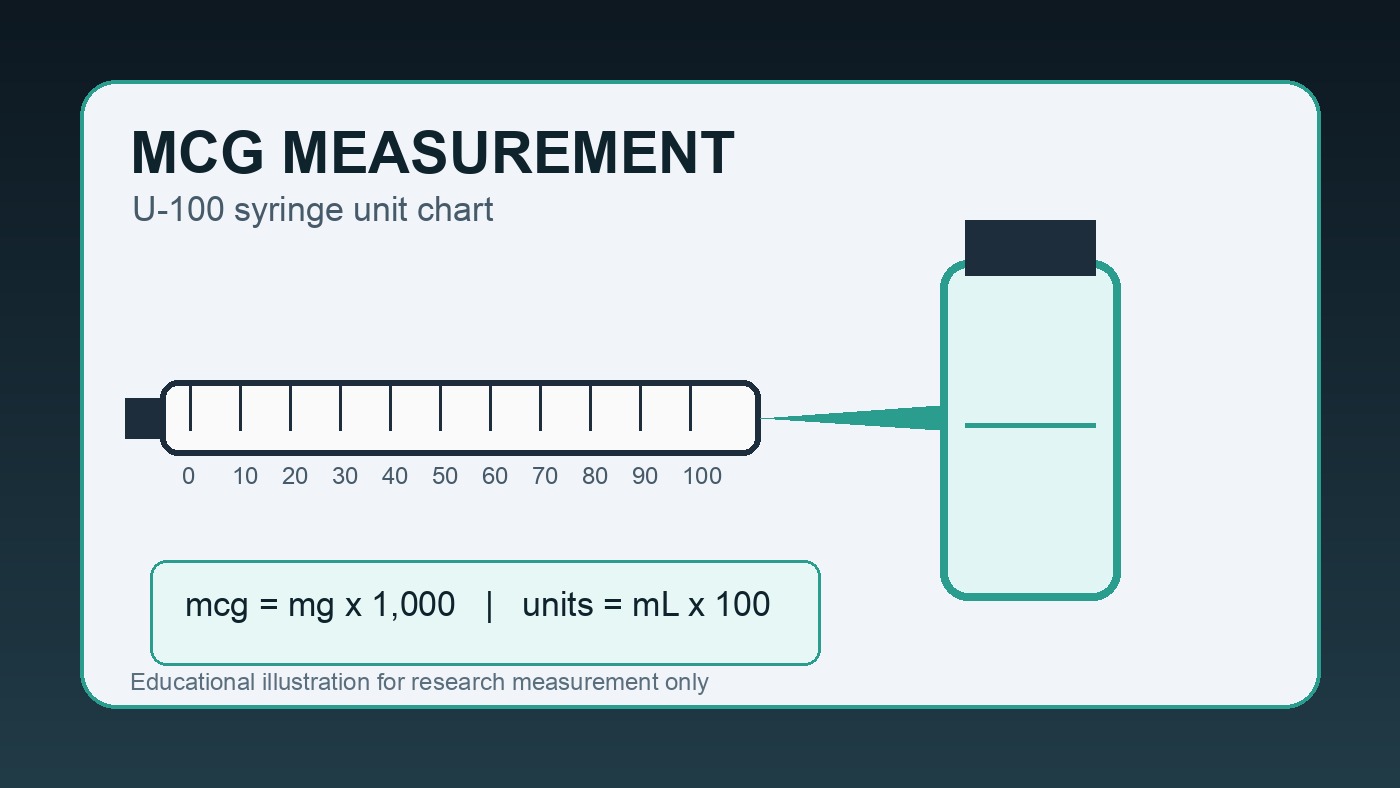
A U-100 insulin syringe has 100 units per 1 mL. That means 10 units equals 0.10 mL, 25 units equals 0.25 mL, and 50 units equals 0.50 mL.
To convert a target amount in mcg into syringe units, first calculate concentration: total mcg in vial divided by total mL added. Then divide target mcg by mcg per mL to get mL, and multiply mL by 100 to get U-100 units.
How to measure peptides in mcg with a U-100 insulin syringe
A U-100 syringe is marked for insulin, but research users often use the same barrel style because the unit marks are easy to read. The unit scale is a volume scale. It does not know whether the vial contains BPC-157, GHK-Cu, semaglutide research material, or plain sterile diluent.
On a U-100 syringe, 100 units equals 1 mL. Each unit equals 0.01 mL. The peptide amount depends on how much peptide mass is dissolved into that liquid.
Need supplies with multiple delivery formats?
Limitless has a large catalog for researchers comparing injectable, spray, and capsule formats. Create the free VIP account first so tracking is credited correctly.
Unlock Limitless VIP Catalog →
118+ research peptides in injectable, spray, and capsule forms - create a free account to view the full catalog
Use code PeptidePick for a discount at checkout
| U-100 syringe mark | Liquid volume | Plain English |
|---|---|---|
| 5 units | 0.05 mL | One twentieth of a mL |
| 10 units | 0.10 mL | One tenth of a mL |
| 25 units | 0.25 mL | One quarter of a mL |
| 50 units | 0.50 mL | Half a mL |
| 100 units | 1.00 mL | One full mL |
This is why a simple unit chart is incomplete by itself. A 10-unit draw can contain 50 mcg, 100 mcg, 250 mcg, or another amount depending on the vial concentration.
The formula for how to measure peptides in mcg
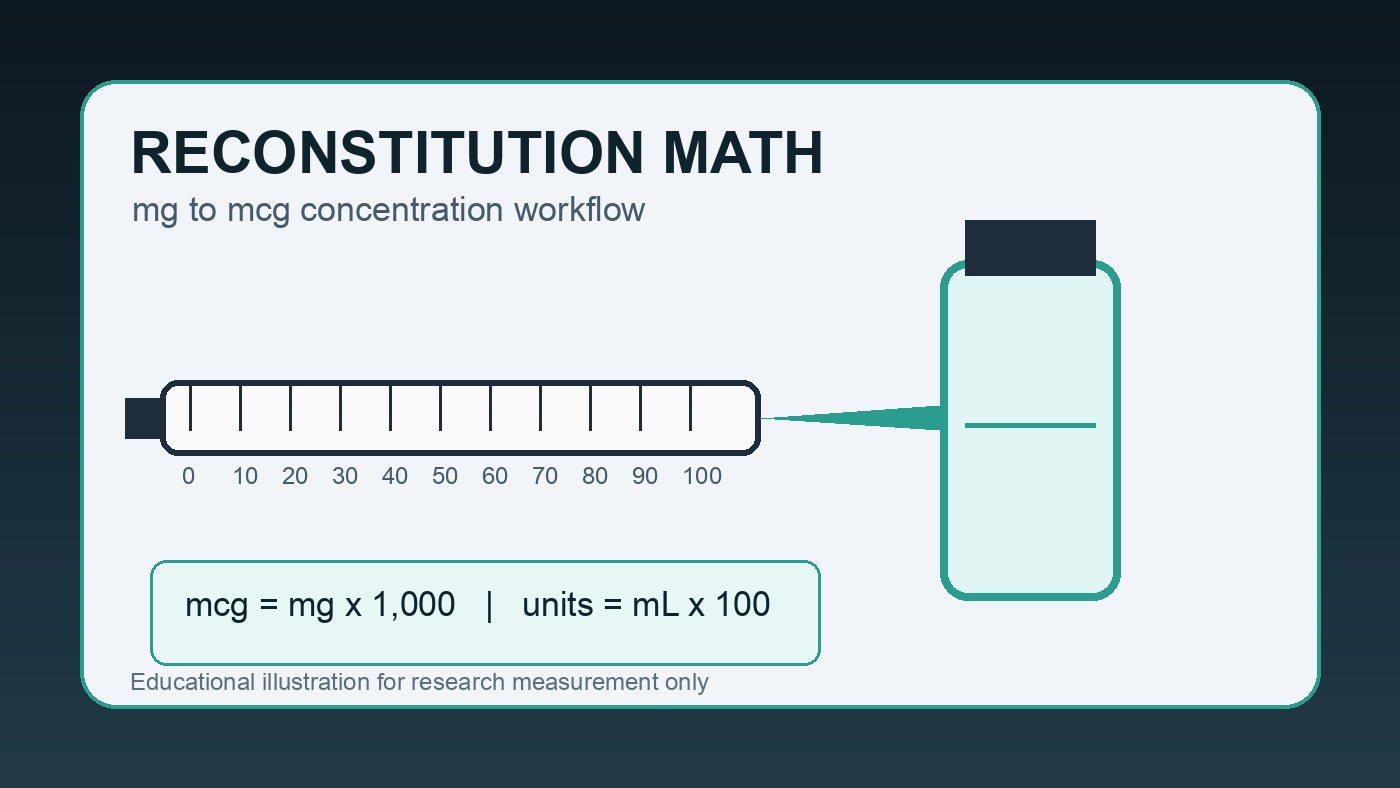
The clean way to calculate a research draw is a two-step conversion. Start with the vial, not the syringe. A vial labeled 5 mg contains 5,000 mcg because 1 mg equals 1,000 mcg.
Then divide that total mcg by the amount of diluent added. If 5,000 mcg is mixed with 2 mL, the concentration is 2,500 mcg per mL.
- Total mcg in vial = mg on label x 1,000
- Concentration = total mcg divided by mL added
- mL needed = target mcg divided by mcg per mL
- U-100 units = mL needed x 100
For a faster cross-check, use the free peptide reconstitution calculator. Then write the math in the research log anyway. Calculators reduce friction, but the written setup is what catches transposed numbers.
Worked examples for 5 mg, 10 mg, and 15 mg vials
Example one: a 5 mg vial reconstituted with 2 mL contains 5,000 mcg total. The concentration is 2,500 mcg per mL. A 250 mcg research amount would be 0.10 mL, which is 10 units on a U-100 syringe.
Example two: a 10 mg vial reconstituted with 2 mL contains 10,000 mcg total. The concentration is 5,000 mcg per mL. A 250 mcg research amount would be 0.05 mL, which is 5 units.
Example three: a 15 mg vial reconstituted with 3 mL contains 15,000 mcg total. The concentration is 5,000 mcg per mL. The same 250 mcg amount is still 5 units because the concentration matches example two.
That last example is the part people miss. Bigger vial does not always mean bigger draw. Concentration is what matters.
Prefer pre-made stacks and clear catalog labels?
Pinnacle is useful for researchers comparing single peptides with stack-style product formats.
Use code Peptidepick15 for 15% off your order
99% pure research peptides - use code Peptidepick15 for 15% off
Common mistakes when converting mcg to syringe units
The first mistake is treating units like micrograms. They are not interchangeable. Units are only marks on the syringe barrel unless the concentration is known.
The second mistake is forgetting to convert milligrams to micrograms. A 5 mg vial is 5,000 mcg, not 500 mcg and not 50,000 mcg. One extra zero can change the draw by tenfold.
The third mistake is copying a chart from a different concentration. A chart built around 1 mL of diluent will not match a vial mixed with 2 mL. It may look professional and still be wrong for that vial.
Medication safety groups have warned for years that unit mix-ups and decimal errors can create serious harm in clinical settings. This article is research-only, but the same math discipline applies. Do not use trailing zeros, and put a leading zero before decimals: write 0.10 mL, not .10 mL.
There is also a storage nuance that does not fit neatly into a chart. Some peptides are more fragile after reconstitution than others. Temperature, agitation, diluent type, and time can matter, so measurement accuracy should sit next to storage notes in the same log.
Research log checklist before measuring
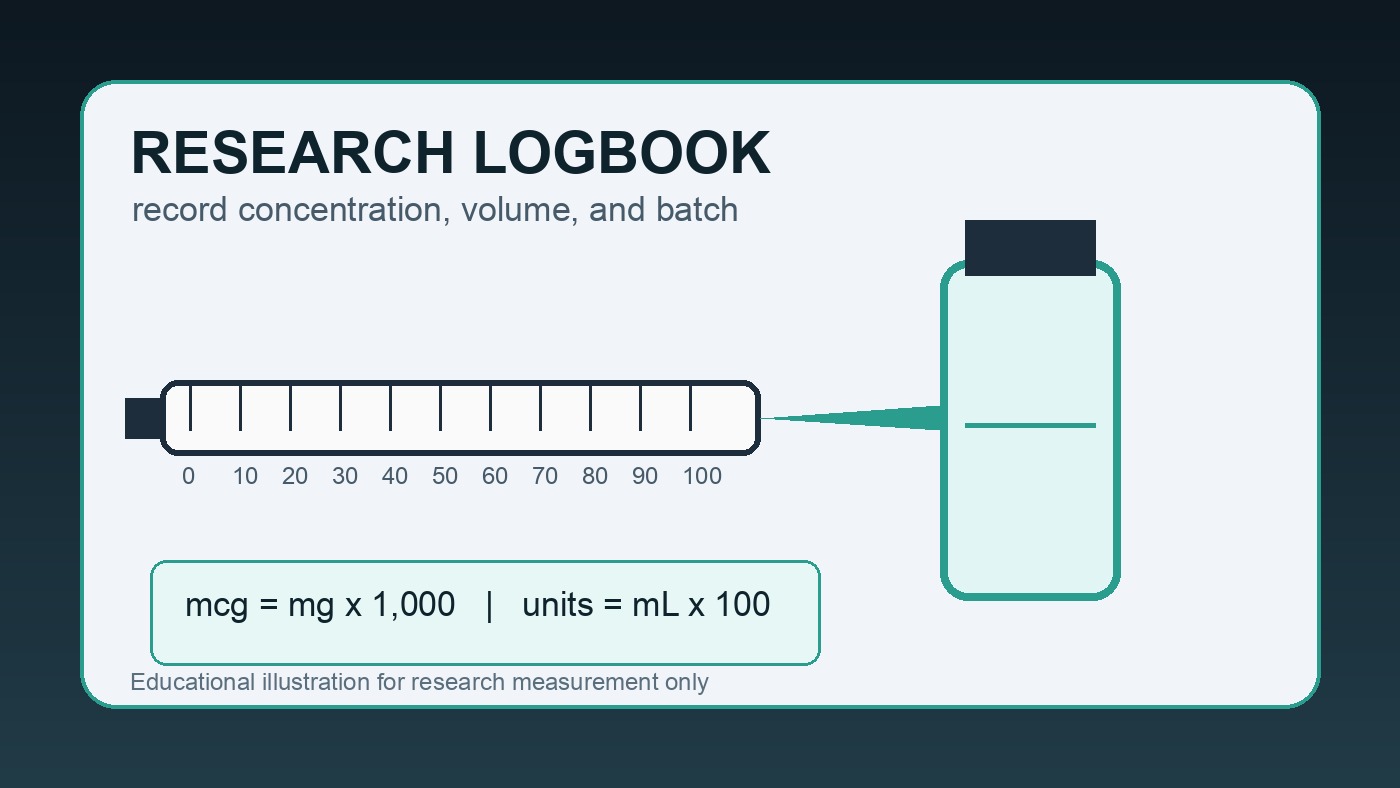
A good peptide log should make the next draw boring. If the next person cannot recreate the calculation from the notes, the notes are not good enough.
- Peptide name exactly as shown on the vial
- Batch or lot number
- Vial mass in mg and converted mcg
- Diluent used and total mL added
- Final concentration in mcg per mL
- Target research amount in mcg
- Calculated mL and U-100 units
- Date reconstituted and storage condition
PeptidePick has a separate step-by-step guide on how to reconstitute peptides. Use that before this measurement chart if the vial has not been mixed yet.
How to choose vendors for measurement-heavy research
Measurement gets easier when the product page, vial label, and third-party testing are clear. Look for direct vial mass, batch details, and testing documentation. If a listing hides basic concentration or identity information, skip it.
For a broader vendor comparison, read the PeptidePick guide to the best peptide companies. Utility articles like this one are less about hype and more about whether the label gives enough information to calculate safely.
Researchers working with timing questions may also want the peptide cycle length guide. For diluent and storage basics, the bacteriostatic water guide is the better next stop.
Need third-party tested research peptides?
Ascension is a solid fit for utility research setups where clear product labeling and broad catalog coverage matter.
Start With Ascension Peptides →
60+ third-party tested research peptides and stacks
Source notes and research framing
This guide uses standard metric conversion, the U-100 syringe convention of 100 units per mL, and medication-safety principles around decimal clarity. PubMed-indexed medication safety literature repeatedly identifies wrong dose, wrong unit, and decimal transcription errors as preventable risk points.
FDA compounding materials also flag that some peptide-related bulk substances can present significant safety risks. That does not make every research compound the same. It does mean sourcing, labeling, and measurement discipline matter more than forum charts.
BPC-157 deserves a special note because many readers use measurement charts for it. The compound is widely discussed online, but much of the early research base traces back to a Zagreb lab group. FDA language for BPC-157 in compounding discussions refers to significant safety risks. Keep that wording precise.
For readers who prefer non-injectable options, Nootropics Depot sells third-party tested oral supplements, not injectable peptides. It can be a supplement alternative for some research-adjacent goals, but it is not a peptide vial source.
Quick reference chart for common vial setups
The chart below is not a universal dosing chart. It is a math reference for research logs. Each row assumes the vial was mixed exactly as shown.
| Vial setup | Concentration | 100 mcg draw | 250 mcg draw |
|---|---|---|---|
| 5 mg plus 1 mL | 5,000 mcg/mL | 2 units | 5 units |
| 5 mg plus 2 mL | 2,500 mcg/mL | 4 units | 10 units |
| 10 mg plus 2 mL | 5,000 mcg/mL | 2 units | 5 units |
| 10 mg plus 3 mL | 3,333 mcg/mL | 3 units | 7.5 units |
Half-unit marks can be hard to read on some syringe barrels. If the math lands on a tiny draw, many research teams change the reconstitution volume so the draw is easier to measure. More diluent lowers concentration and increases the volume needed for the same mcg amount.
That choice has tradeoffs. A larger draw may be easier to read, but it also uses more liquid volume. A smaller draw may be efficient, but small reading errors matter more. There is no perfect setup for every vial.
The best setup is the one that creates a readable draw, matches the research protocol, and can be checked by another person from the written notes. If the calculation cannot pass that test, redo it before touching the syringe.
One practical habit helps: keep a blank calculation template near the storage box. Fill it out before any new vial is used. The template should force four entries - vial mg, total mcg, diluent mL, and mcg per mL. Those four numbers make most unit charts unnecessary.
How to audit a peptide measurement before recording it
Use a two-minute audit before the first draw from any reconstituted vial. Read the vial mass out loud or write it again. Convert mg to mcg. Confirm the exact mL of diluent that went into the vial.
Next, calculate concentration without rounding too early. Rounding at the final syringe-unit step is easier to track than rounding in the middle. For example, 3,333 mcg per mL is close enough for a chart, but the full number may matter in a spreadsheet.
Then compare the result against common sense. If a 250 mcg target suddenly requires 50 units from a concentrated vial, something is probably off. If it requires 0.5 units, the setup may be too concentrated for reliable reading.
Finally, separate research math from medical decisions. A measurement chart can show volume. It cannot decide whether a compound is appropriate, safe, legal, or useful for a person. That boundary matters.
Related articles
- Free peptide reconstitution calculator
- How to reconstitute peptides
- Best peptide companies
- Bacteriostatic water for peptides
- Peptide cycle length guide
- Peptide stacks for beginners
FAQ
How many mcg are in 1 mg of peptide?
One milligram equals 1,000 micrograms. A 5 mg vial contains 5,000 mcg before reconstitution.
How many U-100 syringe units equal 0.1 mL?
On a U-100 syringe, 0.1 mL equals 10 units. The peptide amount inside those 10 units depends on the concentration of the vial.
Why does the same mcg amount change units across charts?
The same mcg amount changes units when the vial concentration changes. A vial mixed with 1 mL is twice as concentrated as the same vial mixed with 2 mL.
Can I measure peptides by syringe units only?
No. Units alone only describe liquid volume. You need vial mass and diluent volume to calculate how many mcg are in each unit.
What is the safest way to avoid decimal mistakes?
Use leading zeros before decimals, avoid trailing zeros, and write both mL and U-100 units in the log. For example, write 0.10 mL equals 10 units.
Does this article provide medical dosing advice?
No. This is an educational research reference. Peptides discussed here are not intended to diagnose, treat, cure, or prevent disease.
Affiliate disclosure: PeptidePick may earn a commission if you buy through sponsored links on this page. This does not change the price you pay, and it does not affect our research framing.