
Peptide Dosage Calculator: How to Convert mg to Units
Peptide dosage calculator math looks simple until the vial size, water volume, microgram target, and syringe markings all collide. The practical problem is not the calculator itself. It is knowing what each field means before a number gets copied into a research log.
TLDR: A peptide dosage calculator converts vial mass and reconstitution volume into concentration, then converts the intended research amount into milliliters and U-100 syringe units. The core formula is: vial mg divided by water mL equals mg/mL. Then desired mcg divided by concentration in mcg/mL equals mL to draw.
- 1 mg equals 1,000 mcg.
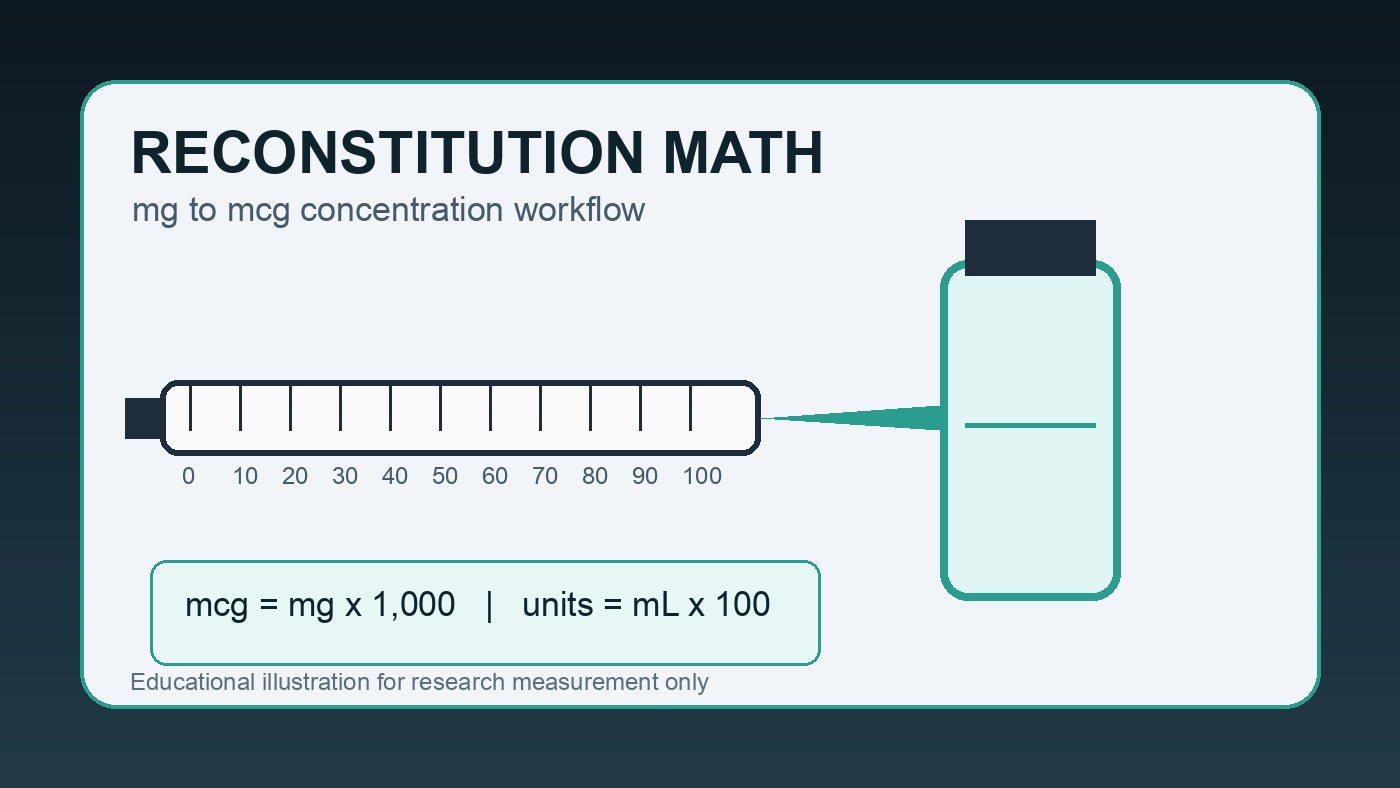
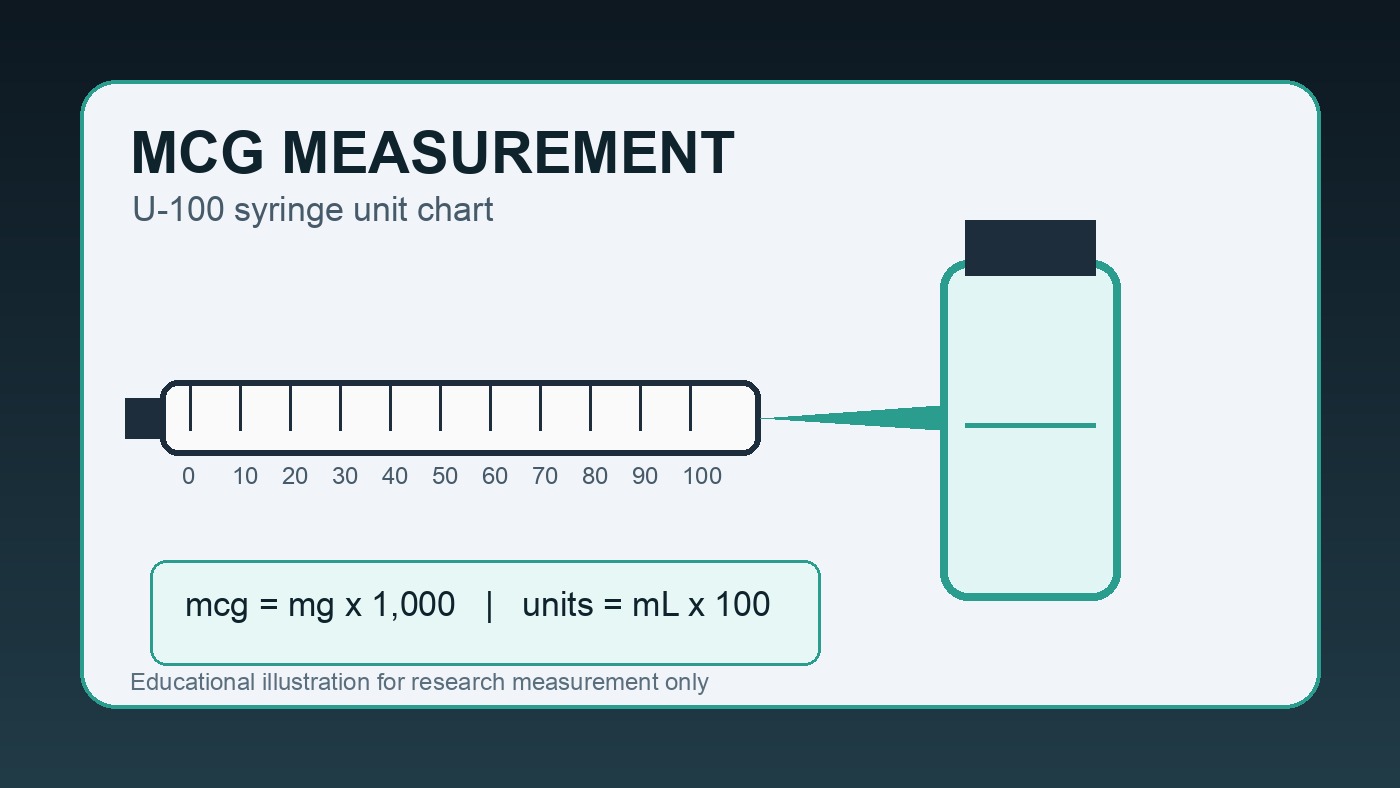
- On a standard U-100 insulin syringe, 100 units equals 1 mL.
- 10 units equals 0.1 mL, 25 units equals 0.25 mL, and 50 units equals 0.5 mL.
- More bacteriostatic water makes each unit less concentrated. Less water makes each unit more concentrated.
How a Peptide Dosage Calculator Works
A peptide dosage calculator is just a concentration tool. It does not know whether a protocol is appropriate, legal, sterile, or safe. It only answers one narrow question: after a vial is mixed, how much liquid contains a chosen research amount?
The calculator needs four inputs: vial mass, reconstitution volume, desired amount, and syringe type. Vial mass is usually listed in milligrams, while research targets are often written in micrograms.
Reconstitution volume is usually entered in milliliters. Syringe type matters because a U-100 syringe uses 100 unit markings per 1 mL, while other syringe formats may not match that conversion.
That last field causes the most confusion. "Units" on a U-100 insulin syringe are volume markings, not peptide potency. A 10-unit draw is 0.1 mL whether the vial contains BPC-157, semaglutide, GHK-Cu, or plain bacteriostatic water.
If you want a live tool instead of doing the arithmetic by hand, PeptidePick has a free peptide reconstitution calculator. This guide explains the math behind it so the output makes sense.
Need research peptides with broad catalog coverage?
Limitless is useful for calculator work because it carries many research peptides across injectable, spray, and capsule forms. Start with the free VIP account link before browsing.
118+ research peptides in injectable, spray, and capsule forms - create a free account to access the full catalog. Use code PeptidePick for a discount at checkout.
Peptide Dosage Calculator Formula: mg to mcg to Units
The cleanest way to avoid mistakes is to move in one direction: milligrams to micrograms, concentration, milliliters, then syringe units.
Step 1: Convert vial mass into micrograms
Most peptide vials are labeled in milligrams. Many research protocols discuss amounts in micrograms. The conversion is fixed:
1 mg = 1,000 mcg
5 mg = 5,000 mcg
10 mg = 10,000 mcg
30 mg = 30,000 mcg
Step 2: Calculate concentration
Concentration tells you how much peptide is in each milliliter after reconstitution.
Concentration = vial mass / water volume
Example: 5 mg vial + 2 mL water = 2.5 mg/mL
That is the same as 2,500 mcg/mL.
This is where a small water-volume change matters. A 5 mg vial mixed with 1 mL is twice as concentrated as the same vial mixed with 2 mL.
Step 3: Convert target mcg into milliliters
Once you know concentration in mcg/mL, divide the desired research amount by that concentration.
mL to draw = target mcg / concentration in mcg per mL
Example: 250 mcg / 2,500 mcg per mL = 0.1 mL.
Step 4: Convert milliliters to U-100 syringe units
A U-100 syringe has 100 units per 1 mL. So multiply mL by 100.
U-100 units = mL x 100
0.1 mL = 10 units
0.25 mL = 25 units
0.5 mL = 50 units
So in the example above, a 250 mcg research amount from a 5 mg vial mixed with 2 mL equals 0.1 mL, or 10 units on a U-100 syringe.
Why the same units can mean different peptide amounts
This is the part that trips people up. Units are tied to liquid volume. Peptide amount is tied to concentration.
Imagine two 10-unit draws. One comes from a 5 mg vial mixed with 2 mL. The other comes from a 10 mg vial mixed with 1 mL. Both draws are 0.1 mL, but the second contains four times as much peptide because the solution is four times more concentrated.
That is why a good peptide dosage calculator asks for both vial strength and water volume. A calculator that only asks for "desired dose" and "units" is missing the variable that controls the whole result.
Peptide Dosage Calculator Examples
These examples are arithmetic examples only. They are not human dosing instructions. Research protocols vary by compound, model, route, and study design.
| Vial | Water added | Concentration | Target amount | U-100 draw |
|---|---|---|---|---|
| 5 mg | 2 mL | 2,500 mcg/mL | 250 mcg | 10 units |
| 10 mg | 2 mL | 5,000 mcg/mL | 500 mcg | 10 units |
| 10 mg | 1 mL | 10,000 mcg/mL | 500 mcg | 5 units |
| 30 mg | 3 mL | 10,000 mcg/mL | 1,000 mcg | 10 units |
Notice the pattern. The target amount alone does not determine the draw. Concentration does. Two vials can require the same 10-unit draw even if the vial sizes and target amounts differ.
Common Peptide Dosage Calculator Mistakes
The first mistake is mixing up milligrams and micrograms. That is a 1,000-fold error. A 1 mg amount is 1,000 mcg, not 100 mcg.
The second mistake is treating "units" as if they mean the same thing across every vial. They do not. Ten units from a 5 mg vial mixed with 2 mL is different from 10 units from a 10 mg vial mixed with 1 mL.
The third mistake is changing the amount of bacteriostatic water without recalculating. If a protocol assumes 2 mL and the vial is mixed with 1 mL, the draw volume changes. The math has to be redone.
There is also a boring but real measurement issue: tiny volumes are harder to measure cleanly. A 2024 study on low-dose insulin accuracy found measurable dosing error at very small target amounts when syringe and pen systems were compared. That does not translate directly to peptide research, but it supports the basic point: very small draws leave less room for sloppy measurement.
For mixing mechanics, storage basics, and vial handling, use the separate guide on how to reconstitute peptides. For water selection and storage, the bacteriostatic water for peptides guide goes deeper.
Prefer a broad research catalog with simple peptide sourcing?
Pinnacle Peptide Labs is a fit for common calculator workflows across BPC-157, TB-500, NAD+, GHK-Cu, GLP research peptides, and premade blends.
Use code Peptidepick15 for 15% off your order
99% pure research peptides - use code Peptidepick15 for 15% off
Research Safety, FDA Context, and Sourcing Notes
Calculator accuracy is only one part of the decision chain. The compound itself matters more.
FDA states that compounded drugs are not FDA-approved and that the agency does not verify their safety, effectiveness, or quality before marketing. FDA also lists certain bulk drug substances that may present significant safety risks. That list includes several peptide-related compounds, with concerns such as immunogenicity, peptide impurities, API characterization, and limited human safety information.
BPC-157 needs extra care in any article about peptide calculations. It originated from research associated with the Zagreb group around stable gastric pentadecapeptide work, but that origin story is not the same as strong human clinical evidence. FDA has described BPC-157 in the significant safety risks context, including concerns around immunogenicity, peptide-related impurities, and limited safety-related information for proposed routes of administration.
So the responsible framing is narrow: use calculators to reduce arithmetic errors in legitimate research planning. Do not use a calculator result as medical advice. Do not assume a research chemical becomes safe because the math is tidy.
Vendor choice should start with testing transparency, catalog fit, and clear research-use labeling. The best peptide companies comparison is the better place to compare vendors side by side. If the project is GLP-focused, see the semaglutide guide, tirzepatide dosage guide, and retatrutide dosage protocol.
For recovery-oriented research compounds, start with the specific protocol article instead of a generic calculator page. PeptidePick has separate research references for BPC-157 dosage, TB-500 dosage for injury models, and AOD-9604 dosage. Those pages cover study context, sourcing notes, and compound-specific caveats that a calculator cannot infer.
For non-injectable supplement alternatives, Nootropics Depot is worth separating from peptide vendors. It sells third-party tested oral supplements, not injectable research peptides. That can fit readers comparing lower-friction options like amino acids, adaptogens, NAD-related supplements, or cognitive-support capsules, but it should not be treated as a substitute source for research peptides. Nootropics Depot is an oral supplement option only.
Quick Checklist Before Using Any Peptide Dosage Calculator
- Confirm the vial amount in mg from the label or certificate.
- Record the exact water volume added in mL.
- Convert mg to mcg before entering a microgram target.
- Confirm whether the syringe is U-100 before reading units.
- Write down the final concentration in mcg/mL.
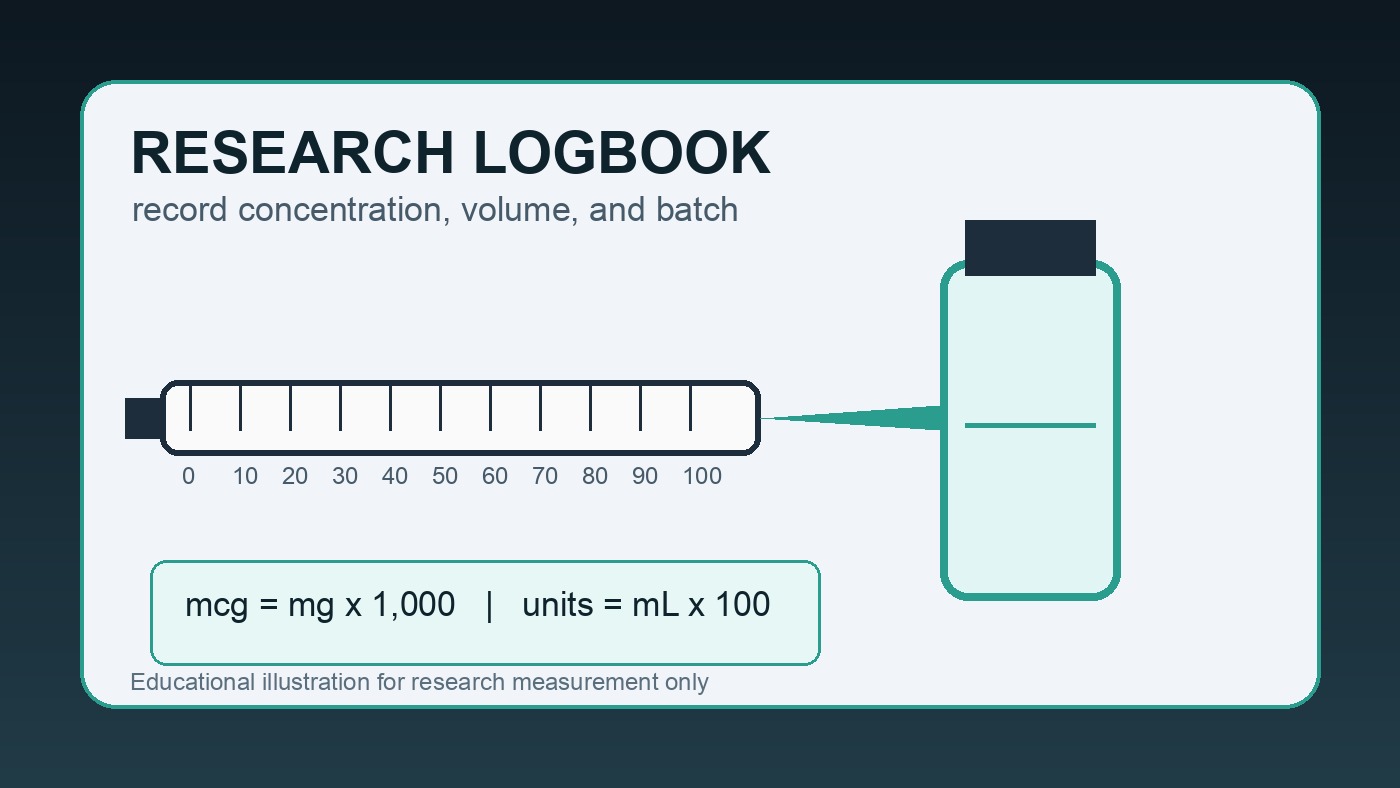
- Keep calculator screenshots or notes with the research log.
There is a bit of nuance here. A calculator can be mathematically correct and still produce a bad workflow if the source data is wrong. The weak link is often the human input: vial mislabeled, water volume guessed, unit type assumed, or a protocol copied without context.
A clean workflow is slower at the start and faster later. Write the vial amount, water volume, final concentration, date mixed, and calculator output in one place. Then label the vial with concentration, not just the peptide name. That habit reduces the odds of looking at an old vial and guessing what 10 units meant two weeks ago.
Need common research peptides plus bacteriostatic water?
Ascension Peptides is strong for recovery, cognitive, skin, and utility research categories, including bacteriostatic water and common peptide stacks.
60+ third-party tested research peptides and stacks
Related Articles
- Free Peptide Reconstitution Calculator - Mixing and Dosage Tool
- How to Reconstitute Peptides
- Bacteriostatic Water for Peptides
- BPC-157 Dosage Guide
- TB-500 Dosage for Injury
- Best Peptide Companies
FAQ
What does a peptide dosage calculator calculate?
It calculates concentration and draw volume. In plain terms, it converts vial mass and water volume into mg/mL, then converts a research amount into mL and U-100 syringe units.
How many units is 0.1 mL on a U-100 syringe?
On a U-100 syringe, 0.1 mL equals 10 units. This is a volume conversion only. The amount of peptide in those 10 units depends on the vial concentration.
Is 5 mg mixed with 2 mL always 250 mcg per 10 units?
Yes, if the syringe is U-100 and the vial is fully dissolved into 2 mL. A 5 mg vial in 2 mL equals 2,500 mcg/mL, so 0.1 mL, or 10 units, contains 250 mcg.
Does adding more bacteriostatic water change the total peptide amount?
No. It changes concentration, not total vial mass. Adding more water spreads the same amount of peptide across more liquid, so each unit contains less peptide.
Can calculator output be used as medical dosing advice?
No. Calculator output is arithmetic. It does not evaluate safety, legality, sterility, diagnosis, route, drug interactions, or whether a compound is appropriate for human use.
Why do peptide calculators use mcg instead of mg?
Many research protocols discuss small amounts, and micrograms make those amounts easier to express. Since 1 mg equals 1,000 mcg, converting first also reduces decimal mistakes.