
BPC-157 Side Effects: Safety, Risks, and What Researchers Track
BPC-157 side effects are hard to pin down because most of the published work is preclinical, the human safety record is thin, and many online reports come from unregulated research-chemical use rather than controlled trials.
TLDR: Animal studies often report favorable healing signals, but that does not prove human safety.
The biggest practical concerns are immune reactions, injection-site issues, contamination or mislabeling, unknown long-term effects, and the FDA's position that compounded BPC-157 may present significant safety risks.
Quick Answer on BPC-157 Side Effects
The cleanest answer is this: BPC-157 has not been studied enough in humans to produce a reliable side-effect rate. A 2025 pilot study reported that intravenous BPC-157 up to 20 mg was well tolerated in two healthy adults, but two subjects cannot settle safety for a wider population.
Most confidence around BPC-157 comes from animal and cell work. That research is interesting. It is also not the same as a human adverse-event database.
Researchers usually separate BPC-157 risk into three buckets:
- Compound-level uncertainty: unknown human pharmacology, dose response, immune response, and long-term effects.
- Route-level risk: injection-site irritation, sterile handling errors, and local tissue reactions.
- Supply-level risk: mislabeled products, peptide impurities, poor sterility, wrong concentration, or degraded material.
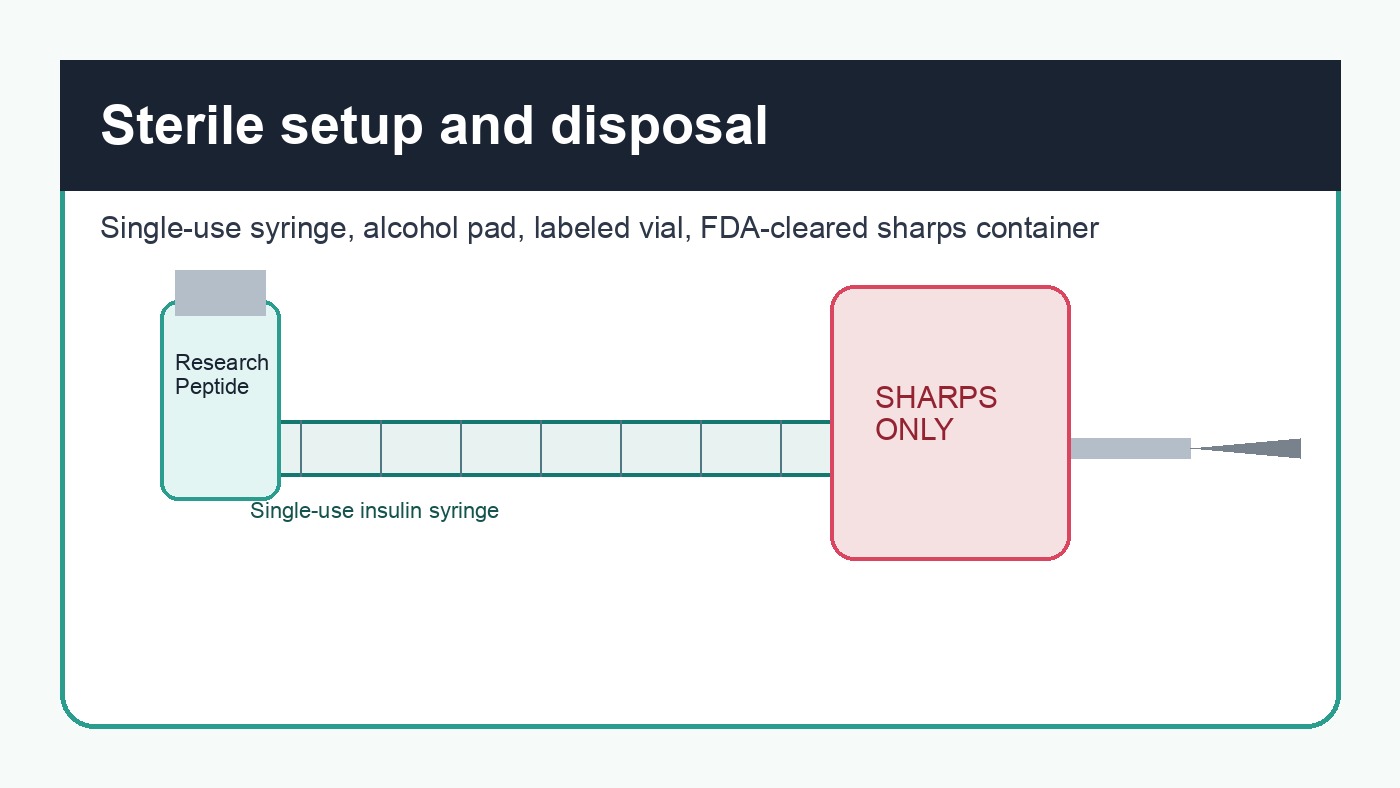
If a research protocol uses injectable peptides, the supporting basics matter too: sterile technique, clear concentration math, and careful recordkeeping. PeptidePick keeps separate references for how to reconstitute peptides, the free peptide reconstitution calculator, and peptide injection site rotation.
Researching BPC-157 With Third-Party Testing in Mind?
Ascension Peptides is the first fit for recovery-focused BPC-157 research because it carries BPC-157, TB-500, and recovery stacks with testing documentation.
60+ third-party tested research peptides and stacks
What Research Says About BPC-157 Side Effects
BPC-157 is commonly described as a stable gastric pentadecapeptide, a 15-amino-acid fragment related to body protection compound research. Much of the original BPC work traces back to the Zagreb research group around Predrag Sikiric. That origin matters because a large share of positive findings comes from overlapping research circles, not dozens of independent clinical groups.
That does not make the research useless. It means the evidence should be read with discipline.
A PubMed-indexed review on gastric pentadecapeptide BPC 157 and wound healing reported few adverse reactions in the available literature, while also stating that more work is needed before clinical use is settled. Another review focused on the nitric oxide system described BPC-157 as active across several injury models, including tissue-healing and vascular-response models.
Those are mechanistic and preclinical signals. They do not answer the reader's main safety question: what happens after repeated human exposure, from different routes, across different health backgrounds?
| Evidence area | What it suggests | Safety limitation |
|---|---|---|
| Animal injury models | Signals in tendon, ligament, gut, nerve, and vascular models | Animal tolerance does not predict rare human events |
| Small human pilot data | A 2025 pilot infusion study in two healthy adults reported no adverse effects | Too small for real safety-rate estimates |
| FDA compounding review | FDA flags immunogenicity, peptide impurity, and API characterization concerns | Regulatory concern is not the same as a quantified risk rate |
This is the uncomfortable middle. BPC-157 is not backed by the sort of large controlled trials readers are used to seeing for approved drugs. But it is also not blank. There are animal data, mechanistic hypotheses, small human reports, and a lot of uncertainty sitting between them.
Reported BPC-157 Side Effects Researchers Track
Because the human literature is limited, serious researchers should avoid pretending there is a settled list of common side effects. A better approach is to track plausible adverse events by route and mechanism.
For injectable research peptides, the most commonly watched issues include:
- Injection-site irritation: redness, swelling, tenderness, itching, bruising, or localized warmth.
- Systemic symptoms: headache, fatigue, dizziness, nausea, appetite change, or unusual sleep changes reported in gray-market use.
- Immune reaction: rash, hives, swelling, fever-like symptoms, or delayed sensitivity after repeated exposure.
- Protocol confusion: wrong concentration, wrong syringe math, poor storage, or repeated use of the same injection area.
- Contamination risk: bacterial contamination, endotoxin exposure, or mislabeled research material.

Stacking makes the signal even messier. If BPC-157 is combined with TB-500, GHK-Cu, growth-hormone secretagogues, or GLP-1 compounds, a reaction cannot be assigned cleanly without a controlled setup. PeptidePick's BPC-157 and TB-500 stack guide covers that problem in more detail.
There is also a tumor-growth question that gets repeated online. The honest answer is narrow: BPC-157 interacts with angiogenesis and tissue-repair pathways in preclinical models, so researchers should be cautious with any model involving uncontrolled cell growth. That does not prove it causes tumors in humans. It also does not clear the risk.
FDA Status and BPC-157 Side Effects Risk Language
The FDA's compounding language is one of the most important safety facts in this topic. The agency has placed BPC-157 among bulk drug substances that may present significant safety risks in compounding contexts.
The FDA specifically points to possible immunogenicity for certain routes of administration, peptide-related impurities, and API characterization complexity. It also says there is no or limited safety-related information for proposed routes of administration, so the agency lacks enough information to know whether the drug would cause harm in humans.
That is stronger than saying the FDA merely wants more data. The official concern is significant safety risk.
BPC-157 is also on the World Anti-Doping Agency prohibited list under non-approved substances. For athletes, that matters even when the compound is labeled for research use.
For readers comparing vendors, start with sourcing standards rather than miracle claims. A broader vendor due-diligence checklist is in the PeptidePick guide to best peptide companies.
Quality, Injection, and Sourcing Risks
Some BPC-157 side effects may come less from the peptide and more from the product. Peptides are sensitive molecules. Heat, moisture, repeated freeze-thaw cycles, poor sterile handling, and bad labeling can all change the risk profile.
For research-use sourcing, documentation should be boring and specific:
- Lot-specific third-party COA
- Purity testing and identity confirmation
- Clear labeled amount in milligrams
- Storage instructions
- Sterility or endotoxin data when the route makes that relevant
Researchers also need clean math. A 5 mg vial reconstituted with 2 mL has a different concentration than the same vial mixed with 1 mL. PeptidePick has a peptide dosage calculator and a BPC-157 dosage guide for research calculation examples.
Need More Delivery-Form Options for BPC-157 Research?
Limitless Biotech is useful when a research plan compares injectable, spray, capsule, or blend formats. Create the free VIP account first to view the full catalog.
118+ research peptides in injectable, spray, and capsule forms - create a free account to view the full catalog. Use code PeptidePick for a discount at checkout.
What Makes BPC-157 Different From Approved Peptide Drugs?
Approved peptide drugs have gone through human trials, manufacturing review, labeling review, and post-market safety monitoring. BPC-157 has not crossed that line in the United States.
This distinction matters because a compound can look promising in tissue-repair models and still be unready for routine human use. Dosing, route, duration, patient selection, interactions, and impurity thresholds all need controlled human data.
MK-677 sometimes appears in the same online conversations, but it is not a peptide. It is an oral ghrelin receptor agonist. Mixing it into BPC-157 peptide discussions makes the safety picture worse, not clearer.
For musculoskeletal research context, related PeptidePick guides cover BPC-157 for torn ligaments, BPC-157 for knee injury, and peptides for tendon repair.

How to Track BPC-157 Side Effects in Research Notes
A decent research log does not need to be complicated. It needs to be consistent.
Track the compound name, vendor, lot number, COA date, vial size, reconstitution volume, storage conditions, route, timing, and any observed reaction. Record the absence of side effects too. Silence in a notebook is not data.
For injection-route protocols, record site location and rotation pattern. This makes it easier to tell the difference between a local injection issue and a broader systemic reaction.
Watch for delayed reactions. A rash or immune-type symptom that appears after several exposures is different from a one-time sting from bacteriostatic water or needle placement.
But the big limit remains: self-reported logs are not controlled trials. They can spot red flags. They cannot prove safety.
Comparing Recovery Peptides and Pre-Made Stacks?
Pinnacle Peptide Labs fits recovery research that compares BPC-157, TB-500, Wolverine Blend, and other stack formats.
Use code Peptidepick15 for 15% off your order
99% pure research peptides - use code Peptidepick15 for 15% off
Bottom Line: How Risky Are BPC-157 Side Effects?
BPC-157 is best treated as investigational. The upside claims are stronger than the human safety evidence supporting them.
Published animal studies give researchers reasons to keep studying BPC-157. They do not erase the FDA's significant safety-risk language, the lack of large human trials, or the quality issues common in gray-market peptide supply.
So the strongest position is boring but accurate: BPC-157 may have promising biological activity, but human side-effect risk is not well quantified. Anyone reviewing it should separate preclinical healing signals from proof of human safety.
Sources Reviewed
- FDA: Certain Bulk Drug Substances for Use in Compounding That May Present Significant Safety Risks, BPC-157 entry, updated 2026.
- PubMed PMID 23755725: Stable gastric pentadecapeptide BPC 157 and nitric oxide system relation.
- PubMed PMID 30915550: Gastric pentadecapeptide BPC 157 and wound healing review.
- PubMed PMID 40131143: Safety of intravenous infusion of BPC157 in humans, pilot study in two healthy adults.
- PubMed PMID 40789979: Narrative review of BPC-157 for musculoskeletal soft tissue healing.
BPC-157 Side Effects FAQ
What are the most common BPC-157 side effects?
There is no reliable controlled-trial rate for common BPC-157 side effects. In real-world reports, people most often discuss injection-site irritation, headache, fatigue, nausea, dizziness, or appetite changes, but those reports are not controlled safety data.
Is BPC-157 FDA-approved?
No. BPC-157 is not FDA-approved to treat any condition. The FDA has flagged compounded BPC-157 as a substance that may present significant safety risks, with concerns around immunogenicity, impurities, and limited safety data for proposed routes.
Can BPC-157 cause immune reactions?
Immune reaction is one of the FDA's stated concerns for certain routes of administration. Researchers should watch for rash, swelling, hives, fever-like symptoms, or delayed sensitivity, especially after repeated exposure.
Are BPC-157 injections riskier than oral BPC-157?
Injection adds route-specific risks such as sterility errors, injection-site reactions, and local tissue irritation. Oral use has different uncertainty around stability and absorption. Neither route has enough human evidence to claim settled safety.
Does BPC-157 increase cancer risk?
There is no solid human evidence proving that BPC-157 increases cancer risk. The concern comes from its interaction with repair and angiogenesis pathways in preclinical models, which makes caution reasonable in any research involving uncontrolled cell growth.
Why do some articles say BPC-157 has no side effects?
Many of those claims lean on animal studies, small reports, or statements from the original research groups. Few reported adverse reactions is not the same as a large human safety database.
Is BPC-157 allowed for athletes?
BPC-157 is prohibited by WADA under non-approved substances. Competitive athletes should treat that as a serious compliance issue.